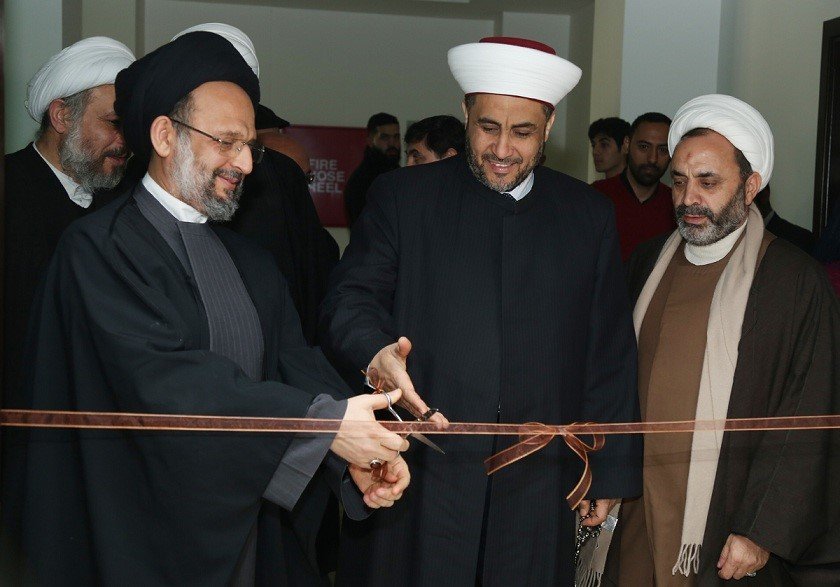
On the occasion of the noble Prophetic Birth, Al-Mabarrat Charitable Association organized the opening ceremony of an artistic tableau addressing stations from the blessed life of the most noble Prophet, at the Al-Saha hotel, in the presence of the president of Al-Mabarrat Association Sayyed Ali Fadlallah, Sheikh Bilal Al-Mulla representing the mufti of the republic Sheikh Abdel Latif Derian, and social and religious figures and interested people.
The ceremony opened with artistic segments presented by the arts troupe at Al-Mabarrat.
Al-Mulla
Then Al-Mulla delivered a speech in which he conveyed the greetings of the mufti, “who is keen to take part with Al-Mabarrat Association and to be present at all its activities, given what this institution represents as an Islamic religious, cultural, national and humane authority”.
He said: “We carry a message of love from Dar Al-Fatwa and a return to the Book of God, so as to confront media, armies, writers and accusations that try to tear this religion apart. We are keen on communication and on meeting, so that we may gather around the Book of God and the sunna of His Messenger and cast aside any hatred that may confront us or that we may confront.”
Fadlallah
Then Fadlallah delivered a speech in which he began by thanking the children “who presented this bouquet of songs, which express the extent of this love and attachment to the Messenger of God, of following his path and of adhering to his line”.
He pointed out “that the institutions of Al-Mabarrat Charitable Association carry this concern in their work, in their effort and in everything they do and offer. We meet here at this ceremony to affirm this love and this relationship, which should be the heading and the character of this stage - for how much we need to benefit from the teachings and the values of the Messenger of God.”
He added: “We fear that we may be in one valley and the Messenger of God in another. The problem is that we carry his name while wronging him and his message. He does not need us to honour him, for God has honoured him; rather we need him - we need to purify our hearts of all this rancour and hatred towards those we differ with, whether in religion, in denomination, in politics or in any other matter. In that way we draw close to the heart of the Messenger, that heart which radiates love and purity.”
He continued: “We need to gather together around the Messenger of God, especially in the shadow of those who seek and work to divide and fragment the Islamic reality through these strifes blazing within it at various levels”, pointing out “that everyone talks about this strife and about who stands behind it, yet everyone falls into its traps and feeds it, whether through their discourse and their words that inflame and provoke sensitivities and fanaticisms, or through many of their positions and judgements”.
He stressed “the necessity of holding fast to Islamic unity in the face of everyone who stands against it or considers that it has ended. Unity is not a choice but a duty we adhere to and work to protect in the face of all these storms that want to strike our reality - storms that have arisen from political conflicts which are meant to be given denominational and sectarian dimensions and which promote strife, whereas what is required is that the slogan of this stage should be: I shall not be safe unless the affairs of the Muslims are safe.”
He asked: “Why should our relationship and our dealings with one another not be as the relationship of the caliphs with one another was - far from all these rancours, disputes, wars and strifes that take place in their name?”
He affirmed “that we must strive to achieve justice in our reality, so that we do not discriminate between one person and another, or between one group and another, or between one sect and another; for it is justice that preserves homelands and eases many of the social, sectarian and denominational tensions”.
He noted “that we reject any injustice to which any human being is subjected, because this injustice constitutes an offence against our values and our principles. We do not distinguish between one oppressor and another, or between a wronged person here and a wronged person there, because we do not determine our positions on the basis of persons or parties; rather we are with values, and we hold others to account according to the extent of their commitment to these values and these principles.”