The simplicity of the idea coincides with its complexity, so that it is distinguished by the comic laugh alongside a tear of veiled suggestion; and thus, for the Lebanese theatre artist “Georges Khabbaz”, plays upon plays are formed.
He lived among people and took from them their anxieties and their language and translated them onto the stage through his writing and his conveying of reality in a simplified and satirical way. People have come to go to the theatre to watch scenes of life that resemble them, for every person's life is a play with heroes among those nearest and perhaps those furthest.
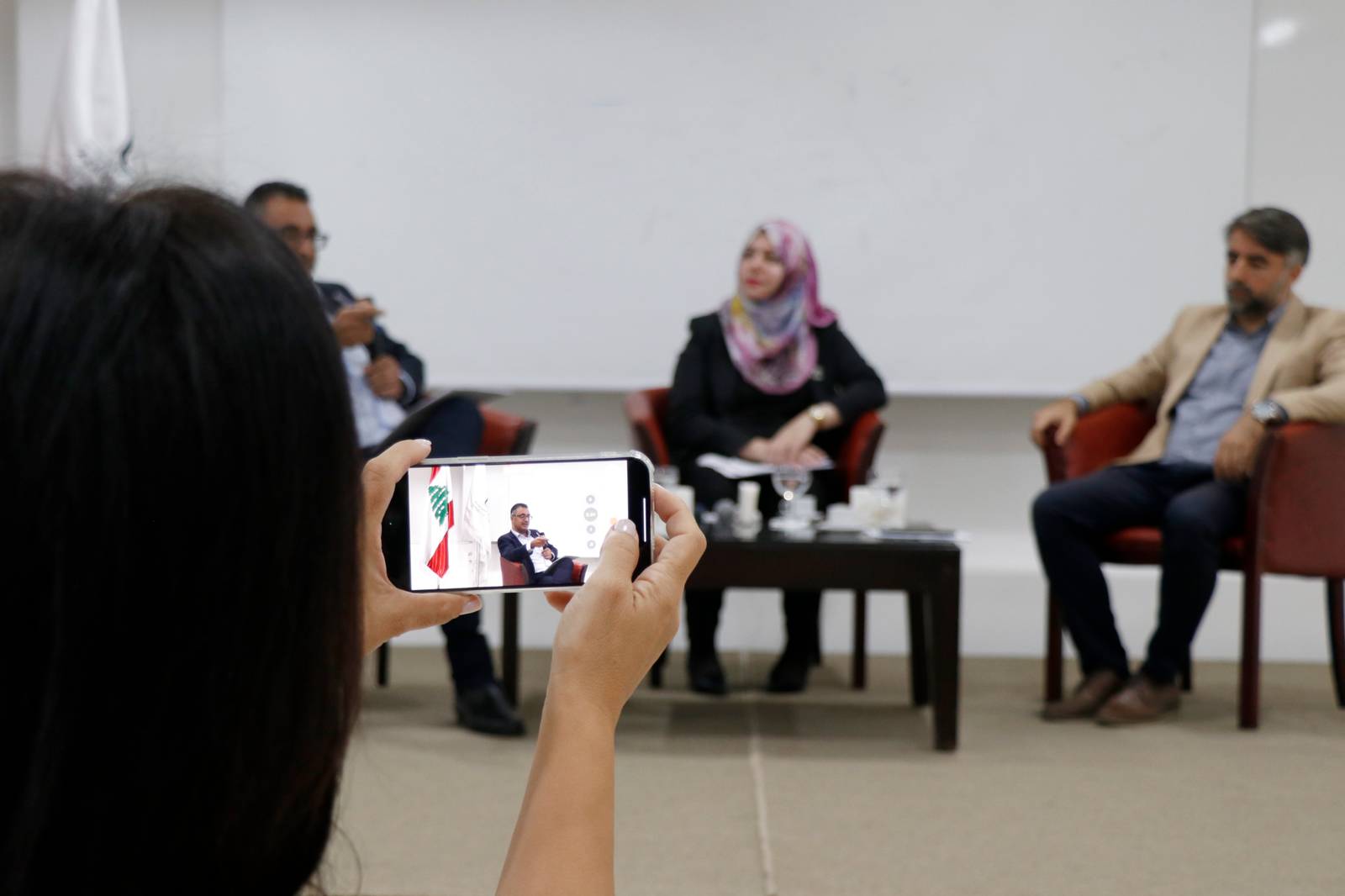
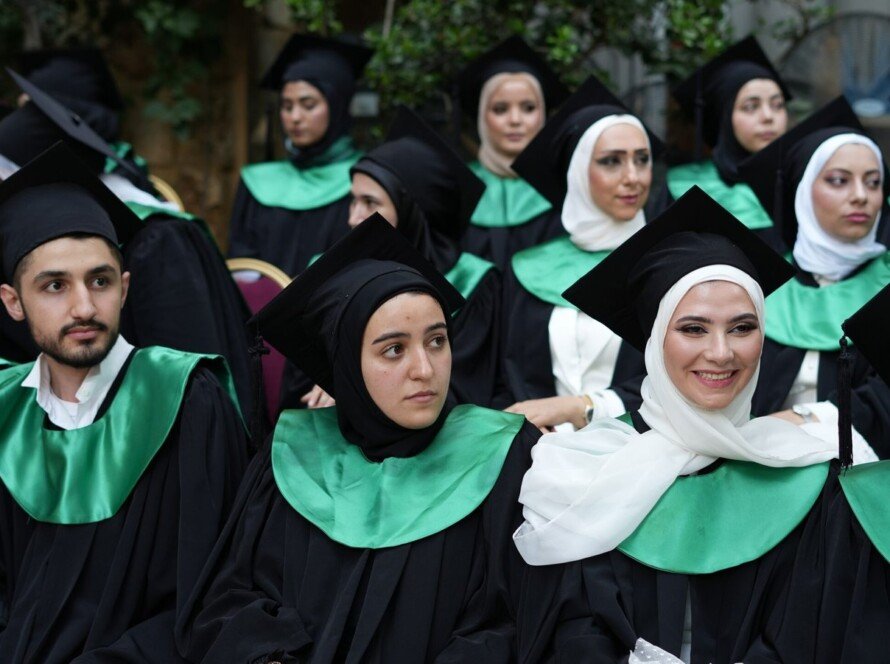
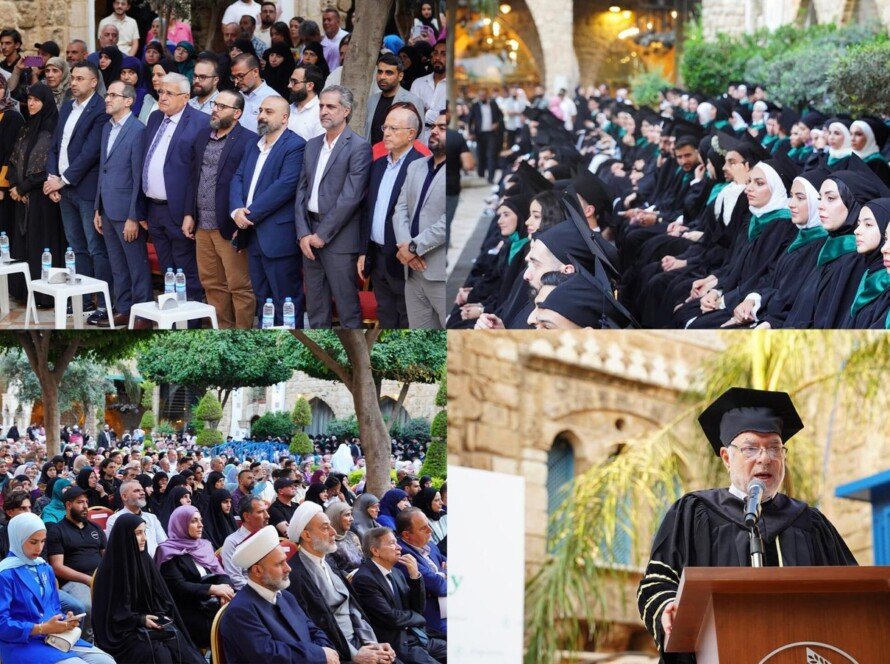
The students of the Faculty of Media at the University of Sciences and Arts in Lebanon held a meeting and dialogue entitled “The Theatre, the Mirror of Society”, on the afternoon of yesterday, Friday 20 May, in the university's hall on the airport road - Beirut.
The meeting began with the Lebanese national anthem, followed by a short theatrical performance acted by the student Mohammad Al-Khashen and the student Batoul Sheet, of a scene taken from the play “Now's the Time”, written and directed by Georges Khabbaz, whose events take place in a castle in the land of “Where the Wind Blows”, which lies on the contact line with unknown enemies “in the year 1900-odd”.
Then the lights dimmed and the screen lit up for the showing of a filmed report about Georges Khabbaz entitled “A Distinctive Mark”, recently broadcast by the Al-Mayadeen channel within a meeting with Khabbaz on the programme “Bayt Al-Qasid”. The report shed light on his personality, and in it he affirmed that the greater pain we suffer as Easterners creates within him a hurt that, through his talent, he has been able to turn into a particular scene. The report covered scenes from his plays, which in his view address all age and intellectual levels, for the theatre is open to everyone: “It is forbidden for us to prevent anyone from entering it.”
Afterwards a set of opinions opposing what Georges Khabbaz does emerged: the students Nour Faraj and Malak Abboud carried out a mini-investigation on the current state of the theatre and the quality of the plays. In it some students of the Faculty of Arts, through their study of the subjects related to the matter, held that the substance of culture in Lebanese theatre does not exist and that it is frequented only by those who want to laugh and hear jokes; that people have no enthusiasm for watching plays; and that when one of them comes out of a Georges Khabbaz play he finds that he has gained nothing new, for the material did not spur him to scratch his head in any particular way, because its message is simple and seeks nothing but laughter.
The actor “Gabriel Yammine” had an opinion on this subject, saying: “Georges's idea is his own; it does not mean it is a message” - that is, his ideas are his own and it is not necessary to generalize them so that they become a message. The theatre does not need an ordinary person; he must be distinguished in his senses and his vision, and the actor resembles a soaring bird, in the view of the theatre actor “Ziad Hawat”.
Afterwards there was a dialogue between the students “Hassan Mudallaj” and “Dina Mchayekh” and Khabbaz, who held that the theatre is the mirror of society, and that it is not necessary for the story to have happened in reality; but the characters in their psychological dimension address the message and the blight that has posed a danger to society. He regarded himself as a son of the people, that is a son of life, and held that culture is no one's monopoly, since he is a many-sided personality: a university lecturer, a director and an actor. This is what gave him dealings with teachers, students and taxi drivers, and so he took from them their anxieties and translated them onto the stage and among the Lebanese public - on the basis that the stage is a truthful, clear mirror and its platform is communicative and interactive, reflecting people's problems.
He spoke of his model in theatrical work, Charlie Chaplin, whom he followed at length during his period of illness, which forced him to sit at home for six months. He memorized his silent scenes and regarded them as the hardest, because the lofty message stays in people's minds if it appears in the right form - in addition to the actor Duraid Lahham, Ziad Rahbani, Shoushou and others.
Khabbaz affirmed that comedy is a mixture of social, economic, political and national issues, which gave him a special personality, until what has come to be known as the theatre of Georges Khabbaz came about. He blends music and acting, since the two are fundamentally interconnected, for theatre is music in the scientific sense.
As for the rights of Lebanese theatre, he held that the theatre is neglected, and that no rights are given to it by a state that has been disintegrating for about forty or fifty years. Lebanese theatre as a whole unfortunately does not address society, for some are concerned with political and sexual instincts. He concluded by saying: “I aspire for Lebanese theatre to have stability, since it has planted its feet firmly over the eight years that have passed; I aspire for this theatre to grow in terms of production and in terms of scope”, hoping that importance would be given to the subject of the arts in all schools so that the pupil may understand from an early age the culture of the theatre, which lays the foundation for his openness to the culture of society.
As usual, after he had drawn laughter and applause with lightness and elegance, he delivered words of his own composition entitled “The world may end, but Lebanon does not end”:
I fear the world may end while we still do not know
No one chose his name, no one chose his origin, neither his form nor his colour, neither his sect nor his religion
And why are we still divided, split and scattered, and under the eyes of the gloaters we slaughter one another in the name of religion
I fear the world may end and my homeland is small and weary of its children, divided between so-and-so and such-and-such
And I hear your voice, grandfather, whispering to me with tenderness: the world may end and Lebanon's story may not end
And as my grandfather told me in that story long ago: the world may end, but Lebanon does not end.
The meeting closed with the presentation of a bouquet of flowers from the media students to the theatre actor Georges Khabbaz with thanks for his attendance, after which everyone moved on to take commemorative photographs.
Among those present were the actress Sarah Qusair, Professor Mohammad Kanso, a group of the university's teachers and a delegation of students from the Faculty of Media and the university's other branches.