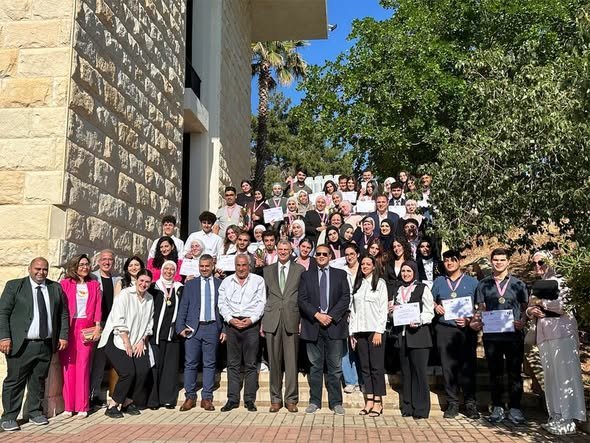
The students of the arts workshop at the Faculty of Media at the University of Sciences and Arts in Lebanon organized a dialogue meeting with the media figure Ghadi Francis entitled “Women in Media and the Difficulties of the Profession”, in which Francis presented her media experience and the difficulties she faced during her journey in the media field, which she began in the press before moving to her television and field work as a correspondent.
Francis affirmed “that women's work in the field of media, contrary to what is commonly held, is easier than men's work”, adding: “Through my experience of covering the war in Syria it became clear to me that a woman journalist has a ticket of entry to any place, including dangerous places.”
Francis said: “The media takes all of the media person's time, and public causes occupy him away from his private life, which it is difficult to balance between the two.”
She pointed out that “the greatest difficulties in media work were not in covering wars nor in the conditions of the detention I was repeatedly subjected to; rather they arise when the media person is free and not mortgaged to anyone, and does not work as a cheerleader or a drum-beater and thereby become a traitor”.
She said: “My duty as a journalist is to be with the truth, with convictions, with general principles; but if I follow a particular person then I become his private media outlet.” She added: “The beating and abuse a journalist may be subjected to is a ‘baptism of fire', because he pays the price of the word of truth he speaks.” Francis held that a journalist should not be saddened if someone abuses him or even loves him: “People are not abusing you but the image they have of you in their heads, and it is an abbreviated, partial and superficial image.”
Francis pointed out that real learning takes place in the field of work, citing the saying of the late journalist Joseph Samaha, “the most important school in journalism is journalism itself”, and stressing that “the media is not a profession like any other profession; it is a person's life, it is a complete belonging and not a shift that ends. It is not a job and cannot be dealt with as a job, and the true journalist gives the profession more than he takes from it.”
She added: “To become a true media person and journalist you must set out from an anger you feel at conditions that are not good; for whoever studies media for the sake of media and has nothing to say, and has no thought and no creed, will find it difficult to be a media person.”
Francis noted that this age grants methods and means that enable the media person to succeed, especially with the development of the channels of communication and social media.