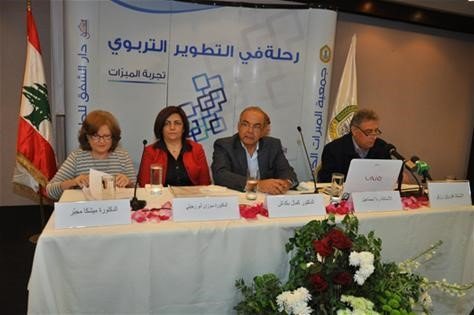
“Al-Mabarrat Charitable” organized a seminar on the book “A Journey in Educational Development”, in which the academic Dr Kamal Bekdache, the academic researcher Michka Mojabber Mourani, the researcher Suzanne Abou Rjeily and the deputy director general for education and teaching at Al-Mabarrat Rana Ismail took part, in the presence of a crowd of interested people and intellectuals.
Rizk
The seminar was introduced by Farouk Rizk, who began by pointing out “that Al-Mabarrat worked so that development should begin with the human being before it begins with anything else - developing the human being by renewing his mind, his heart and his spirit, and by being keen that the human conscience should remain sound so as to sense society's pains, so that we do not turn into beings cold in human terms”.
Bekdache
Bekdache held that the study's results “showed an almost limited fulfilment, or a disparity among the institutions, in the fulfilment of many of the (targeted) administrative practices, and that the programme did not address in its training units concepts connected with leadership practice… It would have been possible beforehand for a number of focus group meetings to give us rich and qualitative information about most and the most important of the effects that resulted from the development programme.”
He pointed out “that the conclusion in this book is that it contains a precise, detailed presentation of an extremely important developmental experience extending over ten years; and readers of this presentation among practitioners and researchers in the field of developing educational administration will find in every one of its chapters something to learn - learning not only what they should do but also, and this is important, what they should not do”.
Ismail
At the start of her speech Ismail pointed out “that some may say that Al-Mabarrat in its practical experience consumed knowledge, since it relied on non-local scientific theories and sought the help of experts outside the framework of its institutions. But whoever reads the book of Al-Mabarrat's experience in development will sense how Al-Mabarrat set out from the theories adopted and regarded internationally so as to live its own experience, and framed it within conceptual and theoretical frameworks of its own, building on its value system on the one hand and on the actual experience on the other”.
She added: “His Eminence Allama Marja' Sayyed Mohammad Hussein Fadlallah long affirmed that idea of his on various occasions and from numerous platforms, so that it became the spur for us to search for a practical translation of the experience of producing knowledge in Al-Mabarrat's institutions.”
Abou Rjeily
Abou Rjeily expressed “her enjoyment in reading this book, which carries within it the distillation of a thought, an experience and a message, making it an educational and scientific reference of the first order, manifested through several aspects, the most prominent being: love of the human being - a love rooted in the thought of the founder, Allama Sayyed Mohammad Hussein Fadlallah, and cared for by the one who took the helm after him… the valuing of the knowledge of experience: the accumulation of administrative and educational experience within our institutions can strengthen awareness and build capacities if we are good at valuing the knowledge produced… reconciliation with scientific knowledge: the reconciliation of the travellers on this journey with themselves and their experiences on the one hand was enough to reconcile them with scientific knowledge on the other. And faith in the ability to bring about educational change: page after page, a stimulating positive energy radiates from this book, springing from a real belief that change in education through education is possible.”