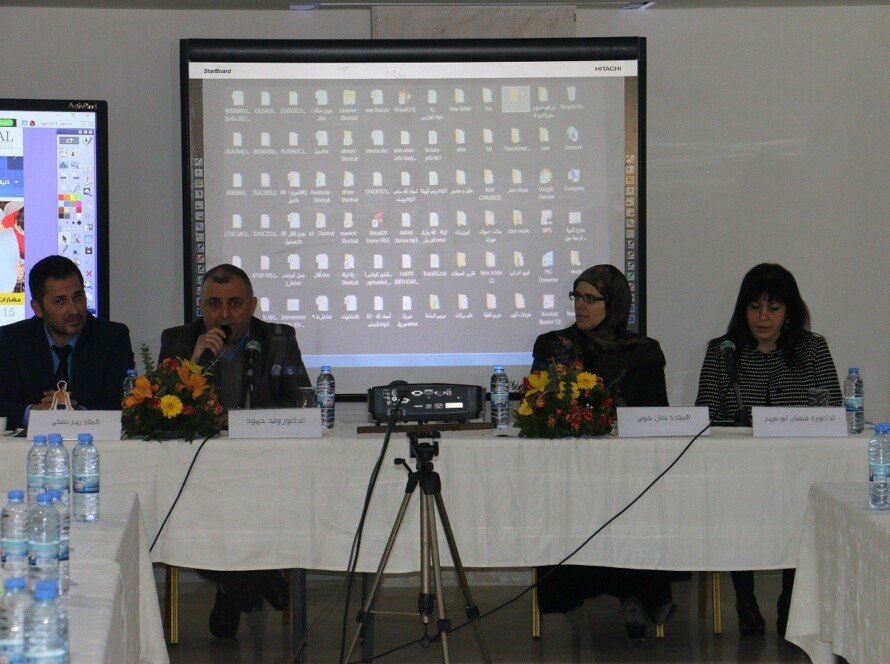
The Faculty of Education at the University of Sciences and Arts in Lebanon organized the conference “Educating and Caring for the Gifted Within Special Education: Challenges and Experiences”, with heavy Arab participation from the State of Kuwait, the Emirates, Saudi Arabia, Bahrain, the Sultanate of Oman, Qatar, Jordan, Syria and Egypt, and with European participation from Germany.
The conference was attended by academics and researchers from various universities, official Lebanese and Arab educational bodies, and practitioners from schools in Lebanon, Kuwait, Qatar and Jordan.
The most prominent speakers at the conference were: Dr. Anies Al-Hroub of the American University of Beirut, the director of the International Centre for Innovation in Education Professor Dr. Taisir Subhi Yamin, the president of the Arab Council for the Gifted and Talented Dr. Atef Kanaan, the expert in the Gulf states Dr. Adnan Al-Qadi, and the director of Rethinkers in Jordan Dr. Lana Al-Mbaydeen, in addition to interventions by a number of experts, practitioners and interested people.
According to the dean of the Faculty of Education at USAL Dr. Walid Hammoud, this conference comes within “the Faculty of Education's orientations in advocating the cause of people with special needs in Lebanon and the Arab world and their teaching and care according to research-based practices and approaches”.
He added: “This conference had been postponed for more than two years after it had been scheduled to be held in October 2019, but the events that took place in Lebanon and the coronavirus pandemic prevented it from being held in person on its date, so it was decided to hold it remotely.”
He pointed out that “the cause of teaching and caring for the gifted can no longer bear delay while waiting for conditions in our country and the region to stabilize, especially as among the justifications for caring for the gifted is achieving society's welfare - which drives us to raise the level of societal awareness of the importance of caring for them, because nations' progress and growth are tied first of all to their human resources”.
On the conference's problematic, the coordinator Nidal Jouni said: “Educating and caring for the gifted in Lebanon and the Arab world within special education faces many challenges, beginning with the problem of defining the least restrictive environment for the gifted, passing through the mechanisms of identification, the curricula, the methods of instruction, the teaching strategies and the management of programmes. Today it is no longer acceptable to regard teaching and caring for the gifted as a luxury compared with the challenges Lebanon faces in teaching those with learning difficulties and various disabilities; rather the pairing of the two paths has become a necessity for the very same justifications that made responding to the needs of those with difficulties and disabilities obligatory: school dropout, the decline in academic attainment and motivation, and low performance and achievement compared with capability.”
She added: “The digital age we live in and the social, political and economic changes make us in the greatest need of making use of the opportunities available to develop our reality - among them the minds of the gifted and high-achieving. Strengthening educational services and practices to the level of meeting the needs of this category of learners within an inclusive environment that strengthens the concept of the right to learning for all will then enable us to face the global challenges and find solutions to them.”
It is noted that the conference's first axis focused on identifying the gifted, how to detect them, and becoming acquainted with the different approaches to caring for the gifted and high-achieving and with experiences from the Arab countries.
The second axis addressed the subject of changing the orientation in teaching and caring for the gifted within special education.
The third axis presented experiences of teaching and caring for the gifted within inclusive schools, in addition to how to train on creative and innovative programmes.
The fourth axis treated the curricula of the gifted and the components of the cognitive curricula in responding to the needs of the gifted and high-achieving and in responding to the emotional and social needs of the gifted and high-achieving.