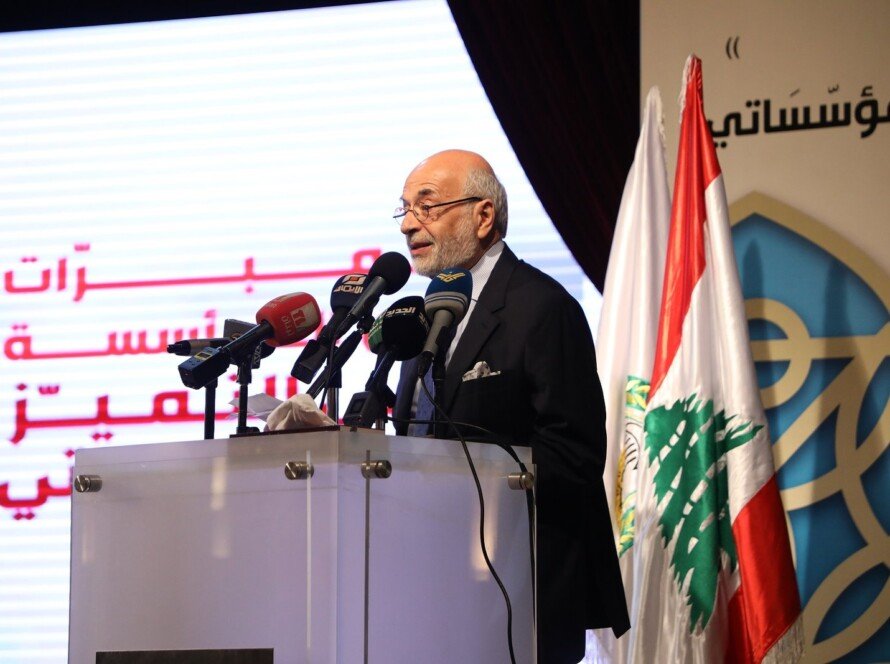
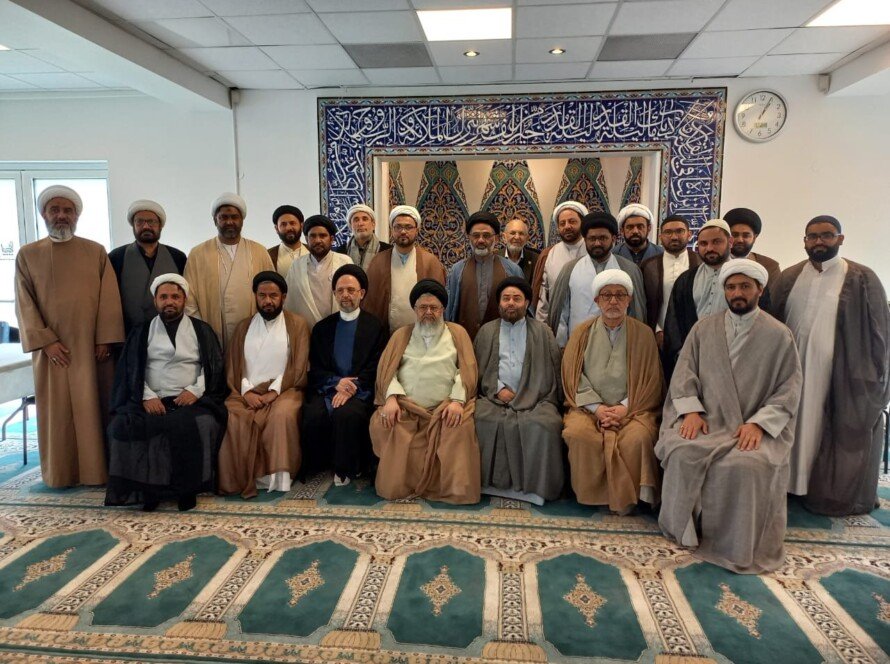
The institutions of the late scholar and religious authority Sayyed Mohammad Hussein Fadlallah (RA) held a large ceremony in the Al-Zahraa (PBUH) Hall at the Imamain Al-Hassanain (PBUH) Complex on the thirteenth anniversary of his passing, attended by a crowd of religious, political, diplomatic, military, party, cultural, municipal, media and social figures, foremost among them MP Ashraf Baydoun representing the Speaker of Parliament Nabih Berri; the Minister of Culture Mohammad Wissam Al-Mortada representing the caretaker Prime Minister Najib Mikati; the deputy secretary-general of Hezbollah Sheikh Naim Qassem representing the secretary-general of Hezbollah Sayyed Hassan Nasrallah; the Mufti of the Republic Sheikh Abdul Latif Derian represented by Sheikh Bilal Al-Mulla; Father Abdo Abou Kassem representing the Maronite Patriarch Cardinal Mar Bechara Boutros Al-Rahi; Sheikh Amer Zein Eddine representing the Sheikh Aql of the Druze Unitarian community Sheikh Sami Abi Al-Mouna; Sheikh Hassan Shaheen representing the Higher Shia Islamic Council; the Minister of Agriculture Abbas Al-Hajj Hassan; MPs Mohammad Raad, Ali Osseiran, Jamil Al-Sayed, Osama Saad, Abdul Rahman Al-Bizri, Ghazi Zeaiter, Amin Sherri, Ibrahim Al-Moussawi, Hussein Jashi, Raed Berro, Fadi Alameh, Rani Abou Hamdan and Hassan Ezzeddine; the lawyer Nashaat Al-Hasaniyeh representing the Progressive Socialist Party; Mr. Rabih Awad representing the head of the Free Patriotic Movement Gebran Bassil; Mr. Tony Al-Hajj representing the Kataeb party; the Iranian ambassador Mojtaba Amani; the Palestinian ambassador Ashraf Dabour; the Sudanese ambassador Sarah Idris; the head of the Iraqi mission Amin Al-Nasrawi; a representative of the Russian ambassador; the Iranian cultural counsellor Kamil Baqer; Brigadier General Ali Nasser Eddine representing the army commander; Brigadier General Hussein Khashfeh representing the director general of the Internal Security Forces; Lieutenant Colonel Ihab Al-Dirani representing the director of General Security; former ministers Naji Al-Boustani, Adnan Mansour and Fawzi Salloukh; and popular crowds that filled the hall.
The ceremony began with a recitation of verses from the Holy Quran by the reciter Sheikh Mahmoud Al-Miqdad, then the Lebanese national anthem, then a poem by the poet Nadim Shoaib, followed by anthems by the Al-Mabarrat choir inspired by the occasion. The ceremony was presented by Sheikh Hassan Bashir.
In closing, the scholar Sayyed Ali Fadlallah delivered a speech which said: The years and the days pass one after another and the longing grows for your face, your smile, your tenderness, your compassion and your support, which used to send hope and optimism into us. Despite the long absence we are still learning from you, drawing provision from your words and your stances and from the inexhaustible spring of your knowledge - not because time froze with you, nor because we in this East are addicted to sanctifying those we love, for you taught us to sanctify nothing but the sacred, but because we still see you among us, your presence lives with us, we drink from the spring of your thought, and we find with you what eases our pains, binds our wounds and raises us to where you rose. We find it in what you left us in jurisprudence, creed, thought, politics and society, and in the world of young people, of women and of children…
We seek guidance from you in your wide openness to the other, every other. You did not close the door of your heart, your mind or your home to anyone; you said to everyone: “My heart is open, my mind is open and my house is open.” Even when you built institutions you worked to establish institutions welcoming to all, and you held that openness is what brings hearts and minds closer, what makes the exchange of views and ideas possible, what helps remove anxieties and fears, and what secures the reaching of common ground - while closed-mindedness and division shut the door on all of that.
We seek guidance from you in the culture of dialogue which you set out and worked for. You held dialogue with everyone at the level of religions, denominations and cultures, and you called for dialogue among civilizations. You closed this door to no one except those who closed it on themselves… You wanted it to be a rational, calm dialogue in place of the language of violence, abuse, insult and provocative talk which, sadly, has come to govern our reality and our discussions, and which we witness in our media and on social media pages whenever there is a difference.
We seek guidance from you in your understanding of religion. You did not understand it as closed-mindedness, hatred and withdrawal from life and from the other; rather you saw it as openness to life and to the other - a religion that cannot clash with the mind, which is the dearest of creation to God, nor with the truths of science, which are His laws, for God's law does not clash with His laws.
We seek guidance from you in your freedom. You were careful to be free in your decision and your positions; you did not submit to the prevailing and the popular nor to the alarms around you. You expressed this in the views you held in jurisprudence, law and thought, and in history, and in all your positions and decisions - and when you called for a review of the religious heritage and subjected its texts to reason, logic, ethical and human values, and the values of justice and human dignity, which the Holy Quran made into rules that may not be infringed.
We seek guidance from you when you held that the religions God sent came to serve the human being, and that He wanted them to complement one another and not to struggle with one another, to cooperate and not to isolate one another - and that if we have witnessed struggles among religions, these did not come from their teachings but from their followers' departure from their values and their turning of religion into an instrument of domination.
We seek guidance from you in the bright hope you used to send into people's souls, and in the optimism to which you called when crises and challenges intensified… You always used to say that if the present does not help us achieve the aims we want, because the balance of power within it is skewed, then we must look with hope toward the future as long as we hold to truth and justice - for God will not leave those who work along this road; He will not leave them alone. Yes, we must do what we can do and leave matters to the Lord of the worlds.
Loyalty to the Sayyed on the day of loyalty to him is through sincerity toward this homeland, Lebanon, which the Sayyed (RA) loved and in which he lived; toward the freedom it enjoys and the diversity of religions by which it is distinguished. But he feared for it from those who wish to tamper with its formula so that it becomes a role rather than a homeland, losing the meaning of its existence when it loses its natural role - which we fear may be what we have reached. He feared that the unrestrained exercise of freedom enjoyed by its sects might become a problem for it and for others when it breaks free of those restraints, turning into human groupings that carry the heading of religion without carrying its values, and that the religious positions which are a safety valve for the homeland and its guide to what is good might become a pliant hand for those who occupy political positions and an instrument of theirs.
He feared for Lebanon from a system in which the human being does not live, and he used to say: “I think of the people of this homeland, that they should live in it their humanity, which guarantees their rights and defines their responsibility - not the sectarian Lebanon in which the men of the sects divide up the spoils and the shares…
Hence his call in Lebanon for the state of the human being, in which a person is respected for their humanity and not for their sect, their denomination or their political position.
The time has come to work in all seriousness to bring the country out of this reality and to create an inclusive national condition that crosses sects - a condition that resists every attempt at domestication and sectarianization within the sects' calculations or to the account of private projects… But that will not happen and will not come about if those who manage the political reality do not emerge from their private and factional calculations and from the spoils they obtained unlawfully and continue to obtain.
Those who care for this homeland are those who make concessions for its sake and who are content when the affairs of the Lebanese are sound - not those who see it as a milk cow for themselves, whose value is measured by the amount of spoils it yields them.
It is shameful that we remain in the stagnation we are in, which appears set to last, on the matter of the presidential election, which may not take place in the coming days - after none of them has shown any readiness to agree on a formula for this country, and none wishes to take a step toward the others, so that the country remains captive to outside bets and interests and waits for someone to bestow a president on it as charity.
Loyalty to the Sayyed remains that Lebanon be strong, its strength in its strength and not in its weakness, so that it may stand against everyone who wishes to tamper with its sovereignty, its security and its stability - and he, may God be pleased with him, spared no effort on this road… From this standpoint the Sayyed supported the resistance in Lebanon in its confrontation with the Zionist enemy and stood by it, and was its impregnable refuge. He saw the resistance as a strength for Lebanon against an enemy that still sees Lebanon as the opposite of its own entity and that never ceases threatening its land, its sea and its air. In this the Sayyed did not set out from a sectarian or denominational dimension; rather he called on the resistance to cross sects and denominations, to widen to the space of the homeland and to work to the account of the whole homeland.
For this reason he called for it not to be squandered or touched, so that it may remain a force deterring this enemy, forming a balance with it and a support for the Lebanese army and not a substitute for it - an army whose capacities we call on all who care for it to strengthen, and to remove the obstacles to arming it, so that it may be able to fulfil its role, to deter this enemy and to confront everyone who plots against its security, its stability and its sovereignty.
At the Arab and Islamic level, loyalty to the Sayyed (RA) is through commitment to what he used to call for: freedom from the influence of the great powers, which do not want rapprochement among its states so that it may remain a milk cow for them; and awareness that the material and human capacities and means it possesses, and its values, enable it to dare to reject external dictates and to deepen cooperation among its states so as to establish its presence among the strong - as an alternative to the policies whose fire has burned it and which have allowed the outside to tamper with its security and threaten its stability and its very being.
Here we commend the cooperation we now witness among the Arab and Islamic states, which we hope will take root and deepen, and will be fortified against those who do not want it to achieve the aims sought from it - the strengthening of internal stability and the prevention of the continued haemorrhaging of blood.
At the same time we call for strengthening cooperation with the other world, Western and Eastern, which we want built on the basis of mutual respect and of taking into account the interests of our peoples, who have the right to live and to benefit from their wealth so as to achieve their peoples' wellbeing. At the same time we want to be friends of the world, even as we warn today against the growing racist tide in the West, whose results we have begun to witness in the continual series of burnings of copies of the Holy Quran, as happened recently in Sweden, to hurt Muslims' feelings, provoke them and drive them to despair - and what we see happening today in France.
The world is in the greatest need of recovering ethical and human values and the logic of justice, and of emerging from the logic of tampering with peoples' interests and resources - which we see as the only road to achieving this world's stability and preventing the fires of war from being kindled in it. There is no world peace without justice and no safety without peoples' right to self-determination, to holding their own decision and to taking their freedom.
And the bleeding wound in Palestine remains, one of whose manifestations we witness today in the crimes taking place in Jenin and the West Bank through the brutal aggression the Zionist enemy is carrying out against this city, which sadly is taking place amid the world's silence. Here we must salute the sacrifices it is making and its steadfastness in the face of this enemy's savage practices.
Loyalty to the Sayyed is in standing with the Palestinian people - he who said before his death, when he was asked on his sickbed whether he was at ease: I will not be at ease until the Palestinian people return to their land and obtain their rights.