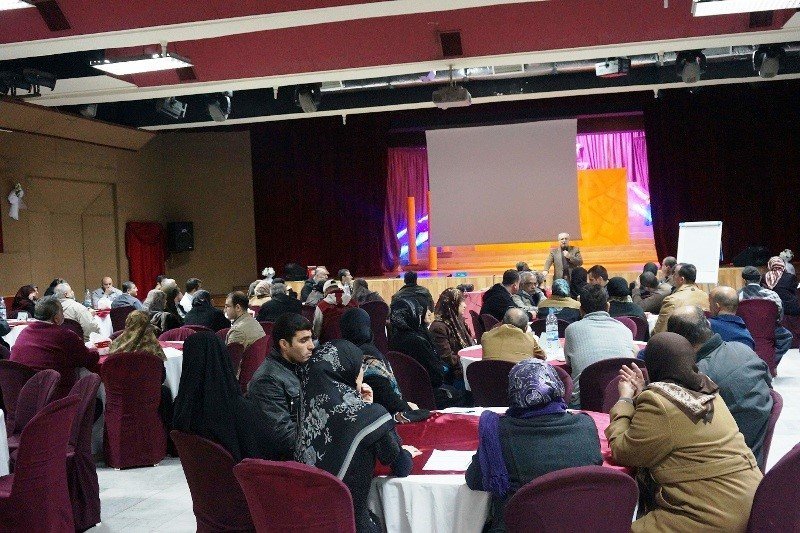
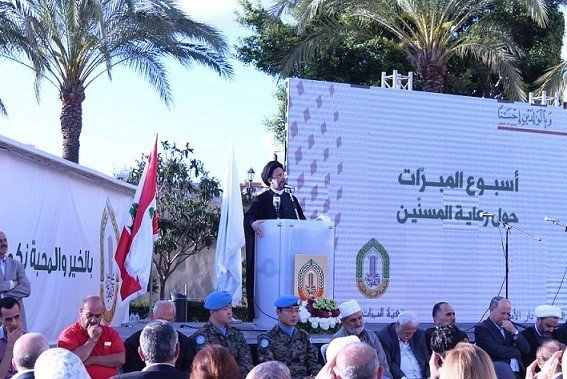
The directorate of care affairs at Al-Mabarrat Charitable Association organized a training course for the new staff in the care institutions spread across the various Lebanese regions.
The course was held at Al-Sayyeda Khadija Al-Kubra Mabarrat on the airport road and covered various administrative, educational, health and religious subjects, with the aim of providing the staff with the basic knowledge and skills connected with their work with the children, who number about 4,000 orphans, difficult social cases and people with special needs.
The course was opened by Souheir Sharara of the directorate of care affairs at Al-Mabarrat, who spoke about the great responsibility resting on the shoulders of the care supervisors in a care institution, and also covered the subjects of the training programme for the year 2015/2016, explaining to the trainees the content of the training and its importance.
The course programme comprised the following workshops:
A workshop on “the job description of the care supervisor”, by the trainer Souheir Sharara, covering the qualities of the effective supervisor, the supervisor's tasks and duties, and the mechanism of his evaluation.
A workshop on “the age characteristics of children”, by the trainer Rola Kanso, which sought to give the trainees information about children's cognitive, mental, motor and sensory development at different age stages, and about how to take account of those characteristics and of the changes that occur.
A workshop on “the instructions connected with the educational follow-up of the children”, by the trainer Ali Tarhini, which highlighted the subjects relating to the educational side of the children, such as the relationship between the mabarrat and the school, supervising the children's studies, and how to fill in the forms specific to educational follow-up.
A workshop on “the skill of time management”, by the trainer Souheir Sharara, which aimed at assessing the extent of the ability to manage time, identifying the successful steps for managing time, as well as ways of benefiting from Parkinson's law and Peter Drucker's principle in managing time.
A workshop on “nutritional balance and the signs of ill health”, by the trainer Joumana Diab, which introduced the trainees to the equations of balanced nutrition and to the effect of unsound food on the body, and on to training the children in how to detect the signs of illness in themselves.
A workshop on “the educational programme in the care institutions”, run by the trainer Mohsina Asaad, covering the educational programme in the institutions and its general aims, and the criteria that must be taken into account when preparing the programme's segments.
A workshop entitled “child protection policy”, by the trainer Rola Kanso, which addressed the procedures and principles on which the child protection policy rests, based on the six stones (approach, consultation, confidentiality, ownership, transparency and sensitivity).
A workshop on “the strategy of play”, run by the trainer Fawzi Al-Dayka, during which the trainees carried out educational activities and games that help in teaching cognitive, motor and psychological skills.
A workshop on “strengthening values and religious gains among the children”, by the trainer Zulfiqar Ayoub, who introduced the trainees to the basic principles and steps in developing values in the children. He also ran another workshop entitled “the religious limits of the relationship between the care supervisor and the children”.
A workshop on positive communication with the parents, by the trainer Souheir Sharara, during which the trainees became acquainted with the concept of communication, the principles of effective communication, and likewise the roles that must be avoided while communicating with the parents and the techniques that help in developing this communication.
A workshop on “educational methods with the children”, by the trainer Rola Kanso, which introduced the concept of behaviour and how to monitor unacceptable behaviour. The trainer also ran another workshop entitled “self-esteem”, during which the supervisors became acquainted with the concept of self-esteem, with the characteristics of high self-esteem and low self-esteem in the children, in addition to the basic elements in building self-esteem.