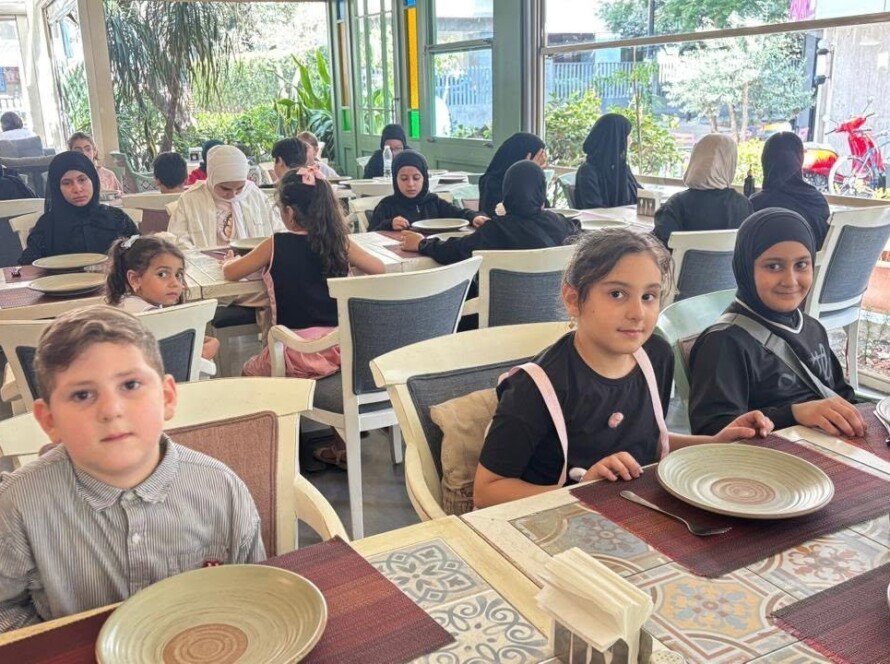
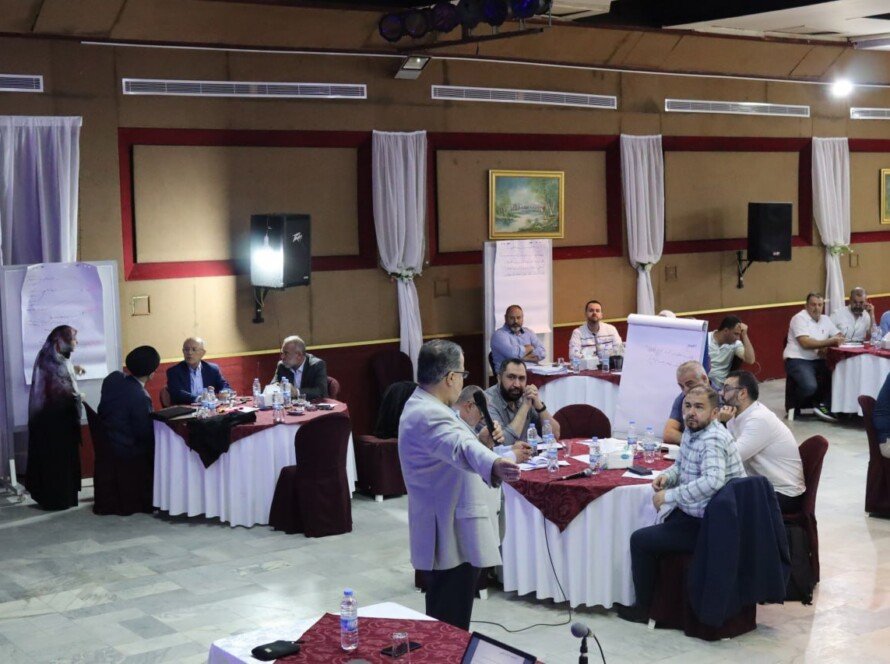
Al-Mabarrat Charitable Association held its annual iftar banquet at the Al-Kawthar complex and Al-Sayyeda Khadija Al-Kubra Mabarrat, in the presence of the deputy Ali Bazzi representing the speaker of parliament Nabih Berri, the minister Ghazi Zeaiter representing the prime minister Tammam Salam, President Hussein Al-Husseini, Father Abdo Abou Kasm representing Patriarch Mar Bechara Boutros Al-Rahi, Sheikh Bilal Al-Mulla representing the mufti Abdel Latif Derian, Sheikh Ali Zeineddine representing the sheikh of the Druze Unitarian community Naim Hassan, the Minister of Industry Hussein Hajj Hassan, the Iranian ambassador Mohammad Fathali, the deputies Ali Osseiran and Walid Sukkarieh, a representative of the president of the Kataeb party Sami Gemayel, representatives of the army commander, the director general of the Internal Security Forces and the director general of General Security, the commander of the embassies security apparatus Brigadier Walid Jawhar, the deputy governor of the Bank of Lebanon Raed Charafeddine, and other figures.
Baqir Fadlallah
The ceremony opened with a speech by the director general of Al-Mabarrat Association Mohammad Baqir Fadlallah, in which he affirmed “Al-Mabarrat's independence in its decisions”, saying: “Since its founding, Al-Mabarrat has not been tied to and has not belonged to any political or party body, internal or external, with our respect for all the political parties and components and their orientations.”
He added: “Al-Mabarrat Association is a charitable, developmental and humanitarian association that works to serve people - all people - without ethnic, sectarian, denominational or factional discrimination. It has contributed and still contributes to achieving social stability through its institutions, which comprise more than five thousand employees. This year it embraces four thousand two hundred orphans, and thousands of orphans have graduated since its launch; it also embraces six hundred and forty people with disabilities, one thousand four hundred people with learning difficulties and two hundred elderly people. Al-Mabarrat also provides social and health assistance through health and social centres.”
He noted that “the expenses of caring for the orphans, the disabled and the elderly last year amounted to eighteen million eight hundred thousand US dollars, along with school and social assistance worth two billion seven hundred million Lebanese lira, and health assistance worth one billion four hundred million Lebanese lira. To these expenses is added covering the deficit of some of its schools in the regions - schools that provide distinctive teaching of high quality. Incidentally, Al-Mabarrat works strenuously so that the orphan and the person with a disability obtain their right to a high-quality education on an equal and equivalent footing with the well-off members of society.”
Fadlallah explained that “the association has opened up to the various institutions in Lebanon - schools, universities, Lebanese and foreign cultural centres and international organizations - and has established partnership programmes with many of them and held various activities for its pupils in participation with institutions of other religions and denominations, in affirmation of the principle of dialogue, in strengthening of communication, and as a test of a positive relationship with the other”.
He touched on “the new projects that will be inaugurated before the beginning of next year, such as the opening of Al-Hawraa Mabarrat in Riyaq - Ali Al-Nahri, which will receive orphans at the start of the new school year; the opening of the Al-Sayyeda Zeinab health and social centre in the town of Jouaiya, which will include a home for the elderly, complementing Dar Al-Aman in the town of Abbassieh; in addition to laying the foundation stone for the building of Imam Al-Rida Mabarrat in Nabatieh, and the purchase of a centre for the boarding section at Al-Hadi Institution in Doha, opposite Imam Al-Khoei Mabarrat, whose construction is being completed. At the teaching level, the preparation of programmes of creative education for the gifted, based on the most recent findings of the international literature in this context and in harmony with the educational methods founded on the value system of the authentic message.”
Ali Fadlallah
Afterwards came a speech by the president of Al-Mabarrat Association Sayyed Ali Fadlallah, in which he thanked those present “for their participation in this Ramadan banquet, and for everything they have offered and offer for the sake of supporting Al-Mabarrat's journey”, pointing out that “the wisdom God intended from fasting is that the rich should feel the suffering of the poor around them, so that this feeling should drive them to awaken their humanity in the face of people's pains - which may best be expressed in the supplication that should be read on every day of the month of Ramadan”.
He pointed out “that the cause of everything we suffer in this world is the dulling of feelings, the loss of a sense of the other human being and the hardness of hearts, to the point where tragedy, pain and suffering leave no trace in us at all”. He added: “It has become part of the vocabulary of politics and the media for some to work at shining a light on tragedies here and stirring up clamour there - not out of humane calculations but for the sake of a political reality, or a sectarian, denominational or nationalist one: a reality that distinguishes between the pain of this group and the pain of that, between one suffering and another, between one set of civilians and another. Then the position is not a humane one but a fanatical, factional one; for humanity is indivisible, and there is no summer and winter in hearts at one and the same time.”
Fadlallah said: “The first way to end the crises is to reproduce humanity in the human being and to mobilize efforts for that end; to restore to the religions their humanization; to affirm that the god in whose name and for whose sake all this blood is drained away and these atrocities are committed is not God, but rather their gods that are worshipped besides God the Merciful, the Compassionate - for God is love; and to restore standing to religion, which came with its chief concern being to call to peace. We must restore to religion the meanings of love, mercy and kindness as an alternative to the logic of hatred, harshness and violence, and make these meanings the ruling standard over any fatwa or decision that contradicts them.”
He affirmed that “every piece of legislation that contradicts love, mercy and kindness is to be cast aside. This does not mean the absolute abolition of harshness and violence, but rather placing them in their proper places, as an exception, and as religion has directed us. Then religion will not be the problem of life but a safety valve for it, a condition of salvation for humanity and a mercy to it; only then will removing religion from life be a removal of all the values of goodness, love and giving that religion watches over so as to consolidate them in the human being and in society.”
He pointed out that “the solution is to take religion out of the hands of those who tamper with it, who appropriate it for their own calculations and take it where they want; to take religion out of the chaos of fatwas and out of the hands of those who interpret it without knowledge or responsibility; to stop employing it for personal and factional interests; and not to regard it as a ladder by which we climb over people's necks. This will not come about unless the weighty religious authorities break their silence and free themselves of all the considerations that bind them, so that their logic becomes the logic of those who convey the messages of God and fear Him and fear no one but God.”
Fadlallah continued: “We shall find the solution when we take religion out of the tribalism that goes under the heading of sectarianism, which makes the relationship between religions and denominations a relationship of struggle over the gains of this sect and the influence of that one, with each party wanting to pull the rug from under the feet of the others, as the tribes of the age of ignorance used to do - thereby turning the dialogue of religions and denominations into a dialogue of interests and of dividing up shares.”
He concluded: “Come, let us meet around our tormented, suffering human being, who endures injustice, oppression, aggression and the diminishment of his rights; for it is his right to live as others live, to have opportunities as others have them, and to develop as others develop. What we lack is to decide; to free ourselves from our fanaticisms; to emerge from all our bloody history, which we constantly summon up so as to strain our reality with it; to emerge from everything that divides, fragments and separates; to rebuild by our own will the bridges we have blown up; to see that what unites us is more than what divides us; to see that giving up particulars for the sake of the interest of the whole is not a concession but a gain for everyone; to know that strength will not come from draining one another and from turning the rifle upon one another, but rather from each of us strengthening the other and from standing in one rank in the face of the enemy that wants to swallow the present and the future - so that it remains the enemy, that we do not replace it with another, and that we do not make truces with it in order to confront one another.”