The Women's Body at the “Al-Mabarrat Charitable” Association held its annual iftar banquet at the Al-Kawthar complex and Al-Sayyeda Khadija Al-Kubra Mabarrat on the airport road, in the presence of women's social, educational, cultural and media figures.
Diab
The ceremony opened with verses from the Wise Remembrance, then an artistic segment presented by the arts troupe of Al-Mabarrat, then a welcoming speech delivered by the president of the association's Women's Body Fadia Diab, in which she said: “The association is a charitable, developmental and humanitarian association that works to serve all people without ethnic, sectarian, denominational or factional discrimination. It has contributed and still contributes to achieving social stability through its institutions, which comprise more than five thousand employees, more than 60% of them women.”
She added: “Al-Mabarrat works strenuously so that the orphan and the person with a disability obtain their right to a high-quality education on an equal and equivalent footing with the well-off members of society. It should be noted that the girls of Al-Mabarrat schools are a source of pride at the finest universities in Lebanon.”
Fadlallah
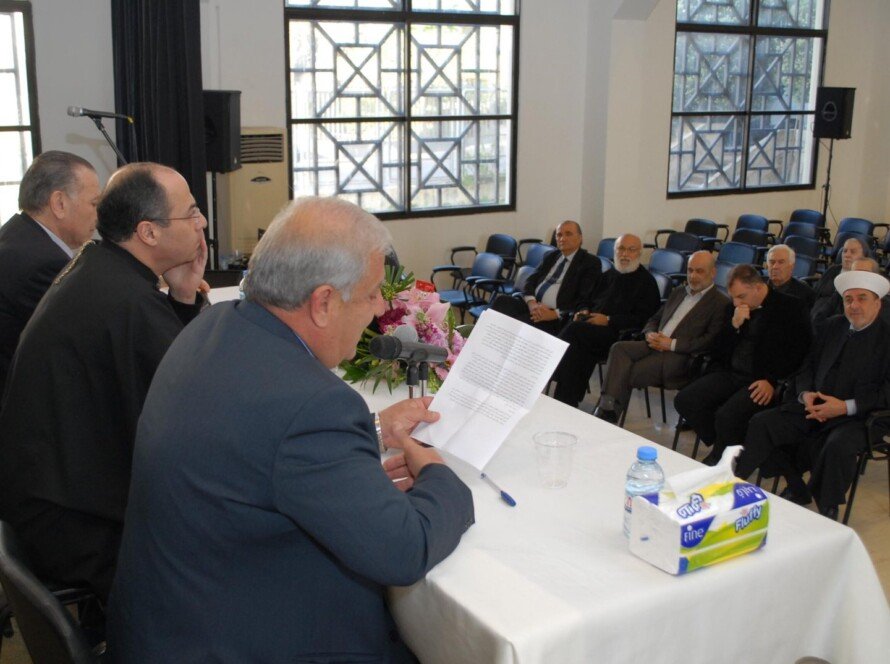
Afterwards the president of Al-Mabarrat Charitable Association Allama Sayyed Ali Fadlallah delivered a speech in which he said: “What distinguishes this meeting and gives it great meaning is that it brings together the whole Lebanese spectrum with all its varieties, its denominations and its political positions. This is what we want for Lebanon and this is what we shall be keen on: our method will remain openness to the other and the deepening of the bonds of love and communication among all people.”
He added: “It is natural that there should be disagreement, for disagreement is one of the ways of life; it is part of its nature and it is not a curse if we deal with it well. But this disagreement should not lead to rejecting the other, or to eliminating him, excluding him or killing him, for this logic has no place in religion. And those who adopt it are not from our history, near or distant: our recent history always rested on the meeting of churches and mosques, on the one mosque entered by the Sunni and the Shia; it was a history of interaction among the religions and of intermarriage among the denominations and the clans, and the great headings were one.”
He continued: “We must deepen the headings of mercy in hearts and of love; we must reproduce love and mercy in the heart, so that we see in the other his humanity before we see his sect or his political position; we must affirm what unites us rather than what divides us, and gaze at the points of light in the other. And who is worthier than you women to spread this - for you are its heading and its example. Among God's mercy to His servants is that He created among them a creature moulded of love and mercy, namely woman; and mercy in a woman is not an artificial mercy but a divine gift, a making of God.”
Fadlallah pointed out that “woman is the heart of the family, the heart of society and the heart of life. She does not need to speak about feelings, for she is in herself a world of pure feelings and sensibilities. She deserves to be honoured for her tender heart filled with love and mercy, and that is why religion called for honouring her. It honoured her for all this overflowing love in her, and for her embodying God's love in her relationship with His creation, for He gives without reckoning as she gives. Therefore offence against woman is an offence against all this value she carries; it is an offence against her love, her mercy and her throbbing affection.”
He continued: “We need laws to protect woman from the domination of man or of society, and we are with every law that contributes to protecting her. And we need to emerge from the traditions that regard the girl as marginal to the boy and the woman as marginal to the man. We need to separate traditions and customs from religion, and to stand against all the traditions that contradict religion and its depth.”
He went on: “Ever since room was made for woman to express her energies, she has proved that she is able to break into every field and to excel in them. Therefore society loses one of its energies when it sidelines woman, as it does when it sidelines her from political or developmental affairs, where she has no presence worth mentioning - neither in the municipal councils, nor in parliament, nor in the cabinet, nor even in the associations that speak about women's rights.”
He concluded: “We do not want a quota for woman; rather we want for her a genuine, effective partnership. The responsibility falls on the shoulders of the influential leaderships, and on the shoulders of woman: that she should trust herself, that woman should trust woman and her presence, and that she should impose herself - for the person who makes himself a need for his society will have everyone bow to him.”