The Faculty of Education at the University of Sciences and Arts in Lebanon organized the exhibition “Educational Technology in the Twenty-First Century” and many accompanying training workshops over the course of three days, on the university's campus on the airport road, under the patronage of the dean of the Faculty of Education at the Lebanese University Dr Thérèse Al-Hashem Tarabay, in the presence of representatives of various educational institutions, and with the participation of companies working in the field of general educational technology and of education connected with people with special needs.
At the opening ceremony the dean of the Faculty of Education at USAL Dr Walid Hammoud spoke, raising many questions “about how to use information technology to provide education for all and to build a culture of continuous lifelong learning; about how to bring about a better balance of fairness in education; and about reconciling the universal and the particular in knowledge”.
He said: “Educational technology has widened the opportunities for freedom of expression and for social, civic and political mobilization, but it has raised great anxieties about the inviolability of private life and about guaranteeing security, especially on the subject of personal information. It has transformed the constituents of the concept of ‘the social', which requires enforceable legal guarantees to prevent excess, abuse and misuse of it.”
He spoke about the exhibition's aims, saying: “Our exhibition today comes in the context of introducing educators and academics to the most recent technological developments in the world and to the ways of using them effectively and employing them optimally in achieving educational outputs, with a particular focus on the technology that assists in teaching and including people with special needs; as well as spreading a culture of the importance and the return of using them in the various educational environments in a skilled and safe way, in harmony with the university's strategic aims connected with developing the skills and competencies of its graduates, which guarantee them ease of entry into the labour market.”
Afterwards came a speech by the ceremony's patron, in which she said: “Technology entered education without asking permission; it broke into the world of education, challenged us and won the wager. Educational technology has imposed its terms, its tools and its means, and the whole educational process now beats to its pulse. And of course whoever does not beat with it is isolated, fades away and disappears.”
She added: “Curricula are now drawn up according to technology's conditions - the aims, the academic content, the teaching methods and the assessment. The aims are deficient if the faculty of educational technology does not appear in them; the educational content is deficient if it does not include it; most active teaching methods rely on it; and assessment has recourse to it.”
She continued: “Educational technology has placed knowledge within reach of those who could not access it; it has offered it to them and respected their capacities, their level of intelligence and their field of interest, and has allowed them to build their knowledge themselves. It has allowed the development of the democracy of education - I mean education for all, and at a certain level of quality. It has broken the cognitive barriers between teacher and learner, since the two can draw knowledge from the same spring; it has likewise obliged the teacher to develop his knowledge and his competencies and helped him to improve his teaching methods, and it has opened before him innumerable cognitive horizons and brought him into the path of quality.”
She paused at Al-Mabarrat's attention to educational affairs, saying: “The message of the long-established Al-Mabarrat institutions rests on the making of love and quality and on the consolidation of noble human values: giving, goodness, justice, equality, empowerment and development. There is also a supreme value that your message possesses and that we sense in all your institutions, namely the value of truthfulness. Without truthfulness you would not have succeeded as you have, and you would not have achieved everything you have achieved.”
She saluted the spirit of Allama Marja' Sayyed Mohammad Hussein Fadlallah, saying: “How glad I am that the opportunity has come for me to address, from this platform, a salute of esteem, admiration and thanks to the spirit of Sayyed Mohammad Hussein Fadlallah, may God have mercy on him, the founder of Al-Mabarrat Charitable Association and the teacher of us all - the Sayyed who taught us how to turn faith into good intentions and good intentions into a building act.”
“The Sayyed's deep spirituality, resting on an aware, open, positive, scientific, liberated mind and on a heart beating with mercy, goodness and the joy of giving - this spirituality established institutions that raise the human being to the highest levels.”
She held that “teaching curricula are before all else a philosophy, ethics, values and principles; the philosophy, the ethics, the values and the principles are the framework that embraces the aims, the teaching means, the methods and the assessment, and not the reverse”.
She called on the officials of educational technology companies to contribute to building the knowledge economy in Lebanon, and said: “Allow me here to draw attention to the fact that it is important that we direct our educational systems towards the harbours of the knowledge economy, the digital field, technology and communications; but we must not leave on the shore the role of education and the human sciences in building the knowledge economy.”
She added: “In much of the literature and many studies, the concept of the knowledge economy is confined to the pure sciences and to industry and technology, while the axis of the human sciences is neglected as though they were second-class sciences whose role is confined to intellectual debates and nothing more. It is the human sciences that turn information into knowledge.”
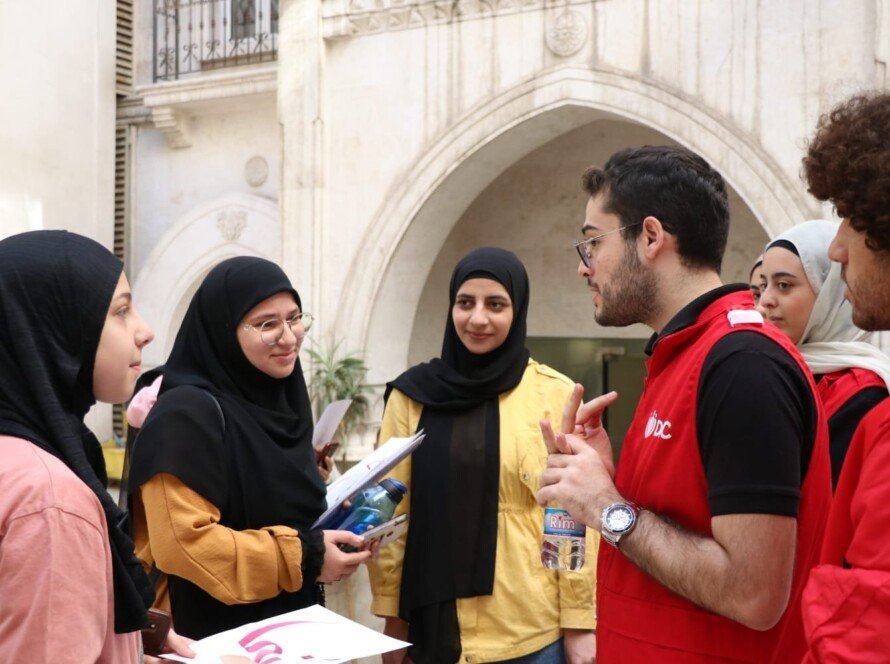
It is worth noting that the training workshops numbered eleven, with about 1,100 trainees taking part from among academics, educators and university students; they centred on testing how to deal with technology, under the supervision of professionals and specialists.