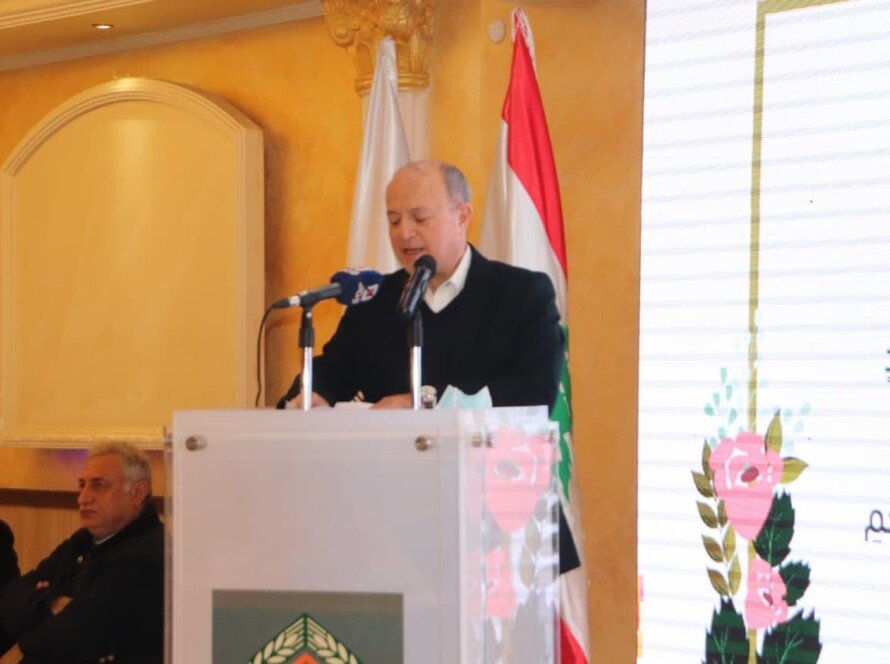
Al-Mabarrat Charitable Association organized the closing ceremony of the activities of the week of the Global Campaign for Education for All at the Al-Saha Heritage Village, under the patronage of the regional director of the UNESCO office in Beirut Dr Hamad Bin Seif Al-Hammami and in the presence of social, educational, cultural, intellectual and religious figures.
To begin with, the principal of Imam Al-Hussein School Hussein Abdallah delivered a speech in which he said: “Al-Mabarrat schools have adopted sustainable human development through an administrative development programme that has covered all the workers in the institutions - administrators, teachers and labourers - in addition to developing the pupil in an integrated way: educationally, pedagogically, mentally, spiritually and physically. From here came the identity of Al-Mabarrat Charitable Association, whose fortieth anniversary of founding we are celebrating this year.”
He added: “We are now in a setting that looks out upon the edifices of Al-Mabarrat, and upon the international literary figure, the researcher, the diligent scholar, the renewer, who built educational edifices and likewise prepared scholars who drew knowledge from his mind, thought from his literature and culture, and a method from his movement.”
He noted that “Al-Mabarrat's engagement with the Global Campaign for Education for All adopted by the UNESCO organization began in 2004-2005, and this year the seventh target of the fourth goal of the sustainable development goals was chosen, ‘Knowledge and Skills for Sustainable Development', since we are living the age of sustainable development and our generation must understand its meaning and the importance of awareness in preserving nature's resources for the coming generations”.
He pointed out that “Al-Mabarrat worked on carrying out numerous activities that take this heading into account, with the aim of strengthening the teachers' awareness of how to design and apply educational projects related to the optimal use of environmental resources, of making the students aware of the importance of environmental resources and of preserving them through carrying out purposeful environmental activities and programmes, as well as of making the parents aware of the concept of sustainable development”.
Yarak
Afterwards Hadi Zalzali delivered the speech of the representative of the director general of education Fadi Yarak, in which he said: “Al-Mabarrat chose the seventh target of the fourth goal of the sustainable development goals, related to ensuring that all learners acquire the skills and knowledge needed to support development and to follow the paths that guarantee the achievement of sustainable development, sustainable ways of living, human rights, gender equality, a culture of peace, the rejection of violence and citizenship.”
He added: “Al-Mabarrat is working at a high pace on achieving all the points in the fourth goal, and we do not exaggerate or depart from reality if we say that Al-Mabarrat, through its work, also achieves a large number of the remaining seventeen goals.”
He said: “The General Directorate of Education has sought to secure education for every child and to form a follow-up committee to achieve the fourth goal. It pursues its basic work of strengthening the educational process in the schools and securing the infrastructure and the equipment needed for it, training the teachers, working on developing the curricula with the Educational Centre and carrying out the central development plan; and it has given the necessary attention to the extracurricular activities related to the sustainable development goals and opened the way for bringing out the students' creativity and talents.”
Ibrahim
For his part, the official in charge of the basic education programme at the regional UNESCO office in Beirut Dr Hijazi Idris Ibrahim delivered the speech of the ceremony's patron Dr Al-Hammami, in which he said: “Our celebration today is a reminder of the aims of education that were agreed internationally in 2015, so that states and educational institutions should strive to carry them out in full by the year 2030. These aims revolve around a principal goal, namely ‘ensuring a good, fair and inclusive education for all and achieving the methodology of lifelong learning'. Here we must look deeply into the content of these goals, and likewise into the challenges and changes that the educational system must prepare to face so as to be able to prepare the coming generation.”
He said: “With the enormous expansion of knowledge and the diversity of its sources, we had to place knowledge in a new context in the field of education and development, such that education becomes the key to knowledge leading to empowerment and comprehensive development. From here came the emphasis on good education as a primary aim for implementation by the year 2030; and in cases of exclusion from education and the marginalization of certain categories, the new educational goals focused on the principle of fairness, inclusion and equality in the opportunities for a good education, whether the excluded person is a refugee, a poor person or a person with disabilities.”
He alluded to the fact that “with the spread of the phenomenon of violence and extremism in its various forms in our region in particular and in the various regions of the world, it was necessary to formulate new aims for education that attend to the emotional and social aspects of education so as to provide peace, implant the values of tolerance and practise responsible citizenship”.
He said: “With the great disparity between the generations and the acceleration of changes in the means of technology, as well as the skills required in the labour market and the speed of their change, the methodology of lifelong learning was adopted, which focuses on making learning opportunities available at all levels and beyond the traditional levels known to us - which are from early childhood to university. The methodology of lifelong learning means adopting strategies of teaching and re-learning in the factory, in the club and in the local community, and adopting strategies of continuous training during service and employment, not only before it.”
He concluded by saying: “Every year the UNESCO organization is keen to remind states of their commitment to the covenants and the educational aims mentioned above. Here the UNESCO office salutes Al-Mabarrat's keenness to organize the celebration, and likewise to carry out activities on the issue of good and inclusive education for all throughout the school year. It thereby establishes a model that we hope the educational institutions in Lebanon will be able to carry out in cooperation with the Ministry of Education.”