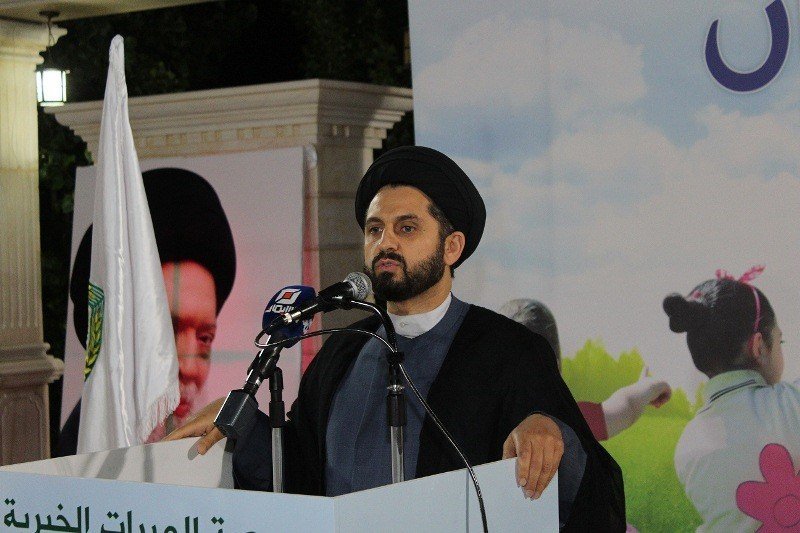
Al-Mabarrat Charitable Association held its annual iftar banquet at the Palace of Kings complex in Ansarieh (the south), in the presence of social, party, educational and municipal figures and religious scholars from the districts of Sidon and Zahrani.
The ceremony opened with a welcoming speech by the director of relations and sponsorship at Al-Mabarrat Jaafar Akil, in which he thanked those present and the supporters of Al-Mabarrat's journey. He said: “Al-Mabarrat's institutions continue to graduate thousands of young people who have built for themselves an entity and a future and who have come to have standing in their surroundings and their society.”
He added: “This is Al-Mabarrat, which works at developing the gifted and watches over the release of their latent energies through programmes based on the international literature; which opens the closed doors before those with difficulties and lets light into their minds, their hearts, their sight and their hearing; and which embraces the orphaned children so that they may leave behind homelessness and loss and enter the world of learning and competence.”
Then came a speech by Allama Sayyed Jaafar Fadlallah, in which he spoke about “the great meanings of the month of Ramadan - the month of people's openness to one another, and the month of meeting around goodness, love and humanity”.
He touched on the subject of the electoral law, saying: “Today people are eliminated from the calculations when many of the political forces discuss the electoral laws that are and are not on the table. Is there really anyone who tells us what the people's supreme interest is today on the strategic range, what the interest of our coming generations and those after them is, and how we can build a homeland?”
He added: “We do not want to talk about the political subject in what concerns the seats and perhaps the anxieties many people live in this country, in the face of all this chaos existing in the region; but let us talk culturally about the electoral law. When we tell people that we do not accept Lebanon being a single district, what are we telling people culturally? We are telling people that you must always narrow your horizon and not look at Lebanon as a homeland but look at your districts. This is an upbringing we are giving people when we tell them that the electoral law we want parliament to approve and on the basis of which people will vote does not speak of a broad horizon but of a narrow horizon - with everything a narrow horizon means of narrowness in relations, in fanaticisms, in quarrels.”
He continued: “When we narrow the district, we narrow the horizon in weaving relations and in their variety among the denominations, the sects and the groups; everyone in it becomes divided against himself. What kind of upbringing is this, in which we shall later find our children closing in upon themselves? We shall see in the future a generation that does not believe in what is shared with the other, and we shall return to a logic resembling isolation and war.”