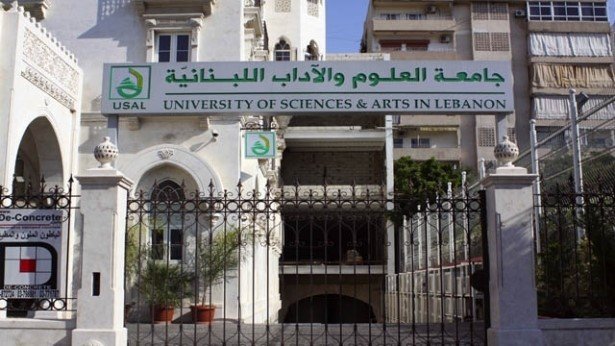
The Cultural Association for Development, headed by Dr Mohammad Baqir Fadlallah - who also holds the post of director general of Al-Mabarrat Charitable Association - obtained a licence to establish the University of Sciences and Arts in Lebanon on the basis of decree no. 1738 dated 14/4/2009, on condition that it begin teaching in accordance with decision no. 1287/m/2012 dated 21/9/2012. As for teaching in English, it takes place in accordance with the licence in the faculties of administrative, financial and economic sciences and their branches, the faculty of arts and sciences with the specializations of computer science and media, and the faculty of education (education and basic teaching - first cycle and second cycle).
The fear of the “worrying” increase in the number of private universities in Lebanon was the principal motive for «Al-Nahar»'s meeting with the university's president Dr Mohammad Reda Fadlallah, in an attempt to acquaint educators with this university's value, its particularity, its specializations and the strategy of its administrative, teaching and student work.
In the university's temporary building in the Ghobeiry area on the old airport road, Fadlallah spoke about the university, which, as he said, “will not be an additional number in the register of higher education but a hard number, because in the general framework of our message we address the Lebanese and the Arab human being”. For him, “the demographic distribution has imposed a nature of students who come to the university from a particular sect, and this contradicts our aspirations, because we hope that Christian and Druze students will come to us, thereby embodying the general shared values called for by Sayyed Mohammad Hussein Fadlallah, especially through his call for the establishment of the state of the human being according to shared values called for by the heavenly religions, the most important of which are truthfulness, justice, trustworthiness and recognition of the other”.
Building knowledge and values
When we asked him to define the university's added value he answered: “What matters to us is to provide knowledge and values to all the students who join our university. We also give attention to providing university scholarships for the orphans of Al-Mabarrat Charitable Association so that they may complete their education at our university. We shall not hesitate to resort to partial or full university scholarships according to the social situation, so as to support any student who genuinely suffers a difficult social condition and to provide knowledge for him.”
In reply to a question about the body funding the university he answered: “The university's board of trustees is working to activate financial support from Lebanese figures and some Gulf friendships that have a special love for Sayyed Mohammad Hussein Fadlallah.” And as to whether Iran supports this academic institution he answered: “Iran has no connection with the funding, neither directly nor indirectly.”
And as to whether the university differs from the Islamic University in Lebanon he answered: “We see ourselves as callers to values, which contradict the mobilizing atmosphere existing outside. Our particularity springs from our wish for openness to the other and our communication with him, and this reinforces the testament of Sayyed Mohammad Hussein Fadlallah, who said: ‘We do not want by this to bring up merely an educated generation, but a message-driven, cultured generation open to its responsibilities in life, so that it may produce goodness for its society and be a generation open to God before and after that, by being an Islamic generation. Therefore you must take this question into account, plan for it and pursue it.'”
It is notable that Fadlallah took up the cause and watched over “solid foundations for the university through two tracks: the first is translated through the complementarity of the work of the university's components, that is the administration, the teacher, the learner, the curriculum and the values; and the second consisted in regarding this year as preparatory for an actual launch next year”.
Fadlallah pointed out “that the question of administration at the university rests on the institution's cohesion and the coordination of its general structure in a way that regulates all the other elements”. In his view, “this cohesion in administration springs from the experience of Al-Mabarrat Charitable Association, which contributed to drawing up a clear structure for the teaching body, for example, which comprises a group of specialized lecturers holding doctorates who realize the importance of Sayyed Mohammad Hussein Fadlallah's teachings and are skilled at generalizing them in the curricula that we support with his spirit”.
As for the second track, according to Fadlallah it rests “on regarding this year as preparatory so that we may set out into stronger experiences”. He said: “About 60 students have joined the university and receive their education from a group of lecturers who are not full-time on the staff.” He added: “We want firm steps for our launch next year in a building larger in area and with the required information technology equipment and a developed library.” For him, Sayyed Mohammad Hussein Fadlallah's testament imposes itself in academic work, because he repeatedly said: “As I always say, I do not want us merely to succeed, but to excel. And not the complex of excellence but the message of excellence, so that we have the ambition of constant elevation, so as to face every challenge that faces you - with love, of course; and we also want to challenge with love.”
For the occasion, he held that “the available specializations had their public this year”. He said: “We provide subjects in French for the education specialization, to which we have added a new diploma in school administration. Our fundamental concern is to prepare, through a special study semester, any student who needs to strengthen his knowledge in mathematics before joining the computer specialization; and the same applies to the Arabic language in the media specialization.”
On another front, the focus on preparing an outstanding generation, as Sayyed Mohammad Hussein Fadlallah enjoined, formed an important part of the conversation, especially about the methods adopted to bring this about. On this subject Fadlallah affirmed “that we do not impose the hijab at our university; rather we ask for modest dress”. He said: “We are committed to an open student life with responsible freedom, far from politics. In the future we shall encourage the formation of clubs, a student life and elections for a representative student body that deals with academic affairs and keeps away from politics and the raising of party slogans.”
And as to whether the university will open up to European and American universities to exchange expertise, he answered: “We aspire to strengthen academic relations between our university and European and American academic institutions, within a purely educational framework, far from politics.”
In conclusion he affirmed that we look forward to building an integrated university campus and to founding branches of the university in the distant regions so as to provide opportunities of knowledge for our young people in the Bekaa and the south, for example. He noted that “we are studying for the future the possibility of fitting out a special section for people with special needs and providing the equipment they require to obtain their university education”.