
Muslims in Lebanon, as in the various Arab countries, are currently living a state of conflict that has carried within it many negative repercussions at the religious, security, social and also economic level. But without the slightest doubt, among the most prominent blights of this futile conflict our Islamic arenas are witnessing is the domination of deviant and corrupt fatwas over the minds of many young people - and worse, that they have turned from words into deeds and then into bombings targeting the innocent…!?
In the midst of this madness dominating many mentalities, the question arises about the role and the importance of the scholars and religious men in society and about how to activate their roles, especially since they are people whose word is heeded, people of trust and justice who enjoy acceptance and respect in the hearts of society.
Many voices ask… Why have the Muslims been divided in their countries while among them are trustworthy marjas and scholars…?!
And why has a group of these not taken the initiative to fill the gulf created by the corrupters among the sons of one homeland… then among the souls of the sons of one religion… then among the followers of one denomination…?!
And what about their role in guiding and directing the politicians towards what is good for the country and the people…?!
And what about their position on the media outlets, which in the height of crises have turned into something like a tank pouring oil on the fire…?!
Many questions are raised and need aware answers that grasp the public interest and work to achieve it…
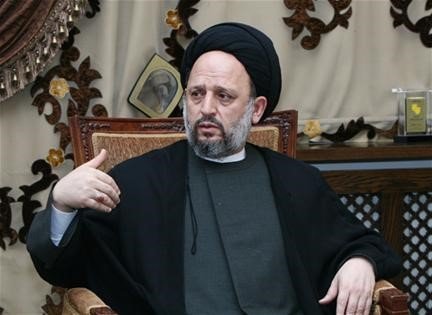
And so… this meeting with His Eminence Sayyed Ali Fadlallah took place:
Activating the role of the scholars
* To begin with, Your Eminence, we ask: what is the role of the religious authorities in combating the extremist thought that has led to the spread of a wave of bombings in our countries?
- The role of the religious authorities is in origin to look after the religious affairs of God's servants, so that they may guide them to the matters of their religion and to the religious duties they are supposed to abide by, so that they may perform their obligations towards themselves and their societies, and so that they may show them the paths leading to deviation so that they may avoid them, according to the rule established by the Messenger of God, God's blessings and peace be upon him: «And whatever the Messenger gives you, take it; and whatever he forbids you, refrain from it.» The role of the religious authorities is a messenger's role, working to guide people to what is good and right for them.
Consequently, among their foremost duties is to warn people against doing everything that could lead them to destruction, whether the matter concerns the destruction of the self or of society. From here we say that the role of the religious authorities is to combat everything that could harm people and their interests, and to address their problems in ways that improve the conditions of their lives.
But the most important thing at this stage is that these authorities should play their role in confronting everything that threatens people's lives, their livelihoods and their property - in the form we have come to see as a result of the spread of the fatwas of religious men who find it easy to issue takfiri fatwas that place people in a state of tension and anxiety and that drive a number of them to blow themselves up, on the pretext that they are performing a religious duty covered by fatwas from those who are not fit to issue fatwas, or from those who are not concerned with the unity and union of the Muslims and do not care if they are divided into sects as a result of their fatwas, or if some of them blow up others for denominational reasons - subjecting the conditions of the Muslims to personal judgements whose result is to draw the country and the people into a circle of enmities and rancours that make terrorism and bombing the only way of expressing the opinions and beliefs that some hold towards others.
* Do you not see that it is a duty upon all the preachers and religious men in Lebanon to organize joint media awareness campaigns to confront these bombings?
- From our religious position we have called and still call for the word of the Muslims to meet on unity, on love and on goodness, because people by their nature are good and care about a safe, stable life far from violence and excess.
Therefore the scholars must respond to people's wish for meeting, dialogue and understanding on everything that concerns the Muslims' affairs, especially when the matter reaches this level of rancour and enmity, in which some do not shrink from blowing themselves up amid people's lives and property…
This reality calls for a serious mobilization by all the sincere scholars who are concerned for people's lives and livelihoods, and for their religion in the first place, so that they may form a great force pushing towards impeding the aims of those who work at takfir leading to bombing - because the greatest loser in the end is Islam and the Muslims. If some danger to people appears, the scholars must show their knowledge, and must stand as an impregnable barrier, united in facing waves of rancour with words of love, and waves of bombing with the unity that combats the acts of killing by these people who are squandering the nation and its societies.
Here duty may call for carrying out media campaigns - statements, press conferences, popular field meetings, initiatives, seminars and lectures - that warn of the dangers of such extreme and dangerous behaviours, which drain the Muslims' strength and turn them into warring sects killing one another instead of supporting one another and backing one another in confronting the enemies of religion and of the nation.
Building requires security
* And what about the authorities' role in pressing the people of politics to agree on what is in the interest of the country and the people?
- We hold that the religious authorities must address everyone who has the power to influence, for the sake of the stability of people's social life and the spread of social security, because we cannot build a sound society in an atmosphere of fear, tension and anxiety. Therefore we hold that the people of politics have a great role in working for everything that spreads security among people and achieves reassurance for them in their daily lives… The people of politics have it in their hands to create the atmospheres that help in this matter.
But - alas - we see them contributing, whether they want to or not, to inflaming disagreements among people and dividing them into parties and sects, because the politicians' calculations are always about how they may invest in their positions, even if that is at the expense of people's security and their interests… We hold the politicians responsible at the national, social and other levels, because among their foremost responsibilities is to solve people's problems rather than complicate them, and to spread security and peace among people rather than make them fanatical and fearful, drawn along behind the instincts rather than behind the use of the mind in solving problems and devising solutions for their various crises.
Dialogue requires good intentions
* Your Eminence… the media in all its forms speaks about a (Sunni-Shia) strife whose horizons loom in the region. So why have we not until today seen a unifying action by the authorities to confront this calamity? And why is no practical Islamic-Islamic plan announced?
- In truth, the scholarly examination of the texts of rupture, dispute, elimination, takfir and compulsion at the Islamic level shows us that they are falsified or truncated texts: they may lack a scholarly chain of transmission, or carry interpretations that take them away from their true meaning, especially in questions of unbelief and faith and other sensitive matters, or be torn from their textual context and their particular setting - as with the extraction of the verses of fighting or of rupture from their context, their circumstances and their considerations, so as to justify violence and to regard it as a rule in dealing with the other.
On this level, in the efforts of the great scholars and jurists of the Muslims we have great hope of showing Islam in its shining human image, resting on the heading of the vast divine mercy that overflows upon all human beings, except those who deny and obstinately oppose all human values.
These orientations lay the foundation for an authentic coexistence, and bring the concept of partnership - governed by the sectarian and denominational discourse that masks itself with religion and morals - out into the expanses of the one religion and the shared humanity, on the basis that the moral ideal, in its truth and its depth, contradicts and conflicts with this existing reality, dismembered denominationally and sectarianly.
As for the practical plan to translate these values and principles, we call for holding unifying seminars, joint study centres, and scholarly academies that teach religion and jurisprudence according to all the denominations, in addition to carrying out joint social and youth activities.
But all that needs people of good and aware will among the Muslim religious scholars, and it also needs the voices of the great wise men among the nation's scholars, so that they may begin the project of mending the crack within its structure. We ask God to help the Muslims to achieve this aim.
* The souls of young people are charged with corrupt ideas that increase the flame of strife. So how can society - scholars, preachers, politicians and media people - confront them with deeds and not with words?
- We believe that young people are the pillar of society and its living nerve: if the young are sound, society is sound; and if this vital segment is corrupted, society is corrupted. The accomplishments achieved by human societies are achieved thanks to the minds of young people, their activity and their ability to confront the problems that arise in society. If these young people are not qualified to bear the burdens of individual and social life, then society becomes a sick society, soon afflicted by setbacks and exposed to every kind of danger threatening its personal and its human existence. Therefore we say that responsibility for young people, for guiding them and making them aware, is a shared responsibility among the religious scholars, the media outlets and the men of politics; for all the exhortations to the young are of no use if there is a “machine” of incitement playing a destructive role with the minds of these young people. We call for youth meetings to discuss the problems these young people suffer, so as to study them with the people of sound minds among the scholars, the media people and the politicians. As for leaving this category prey to incitement by people of sick souls, their division in an atmosphere of strife will turn them all into fuel for it - and this is what is happening today, alas.
* Finally, what is your call to the preachers, the authorities and the people of politics in such painful circumstances?
- As we have said before, reforming society and confronting its varied problems, especially what relates to strife, is the responsibility of every capable member of society and the responsibility of every person in charge in the nation, whether a scholar, a politician, a media person or otherwise. Here we do not overlook the role of the parents and the social settings, for as the hadith says: «Every one of you is a shepherd and every one of you is responsible for his flock.» The great dangers surrounding our societies cannot be confronted individually, or by one party to the exclusion of another; rather all efforts must be joined and all means deployed for the sake of emerging from these great crises that have begun to convulse our societies and that will make all our works like ashes in a strong wind on a stormy day. The dangers are great, and the confrontation of these dangers must be at the same level and scale… Words are no longer of any use against the dangers besieging us; work is necessary - aware, responsible work that places the interest of the nation and of society above every factional, sectarian, party or denominational consideration. If we are able to do that, then we may save our society from destruction; otherwise all the words sent out into the open air will be of no use to us, without finding in minds, hearts and ears any echo worth mentioning…


