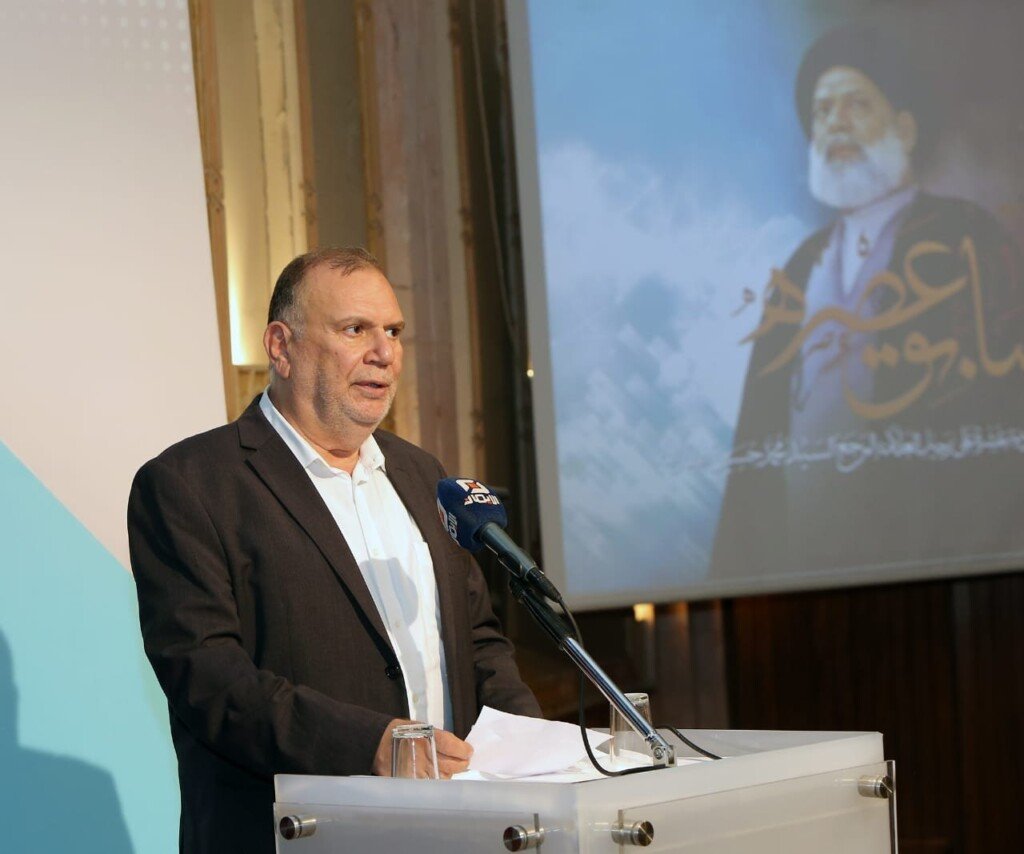
The institutions of the Marja Allama Sayyed Mohammad Hussein Fadlallah (may God be pleased with him) marked the eleventh anniversary of his passing with a ceremony held in the Al-Zahraa (a.s.) hall at the Al-Hasanain (a.s.) complex in Haret Hreik.
The ceremony began with a recitation of verses from the Holy Quran, then a poem by the poet Dr. Mohammad Ali Shamseddine, after which the children of Al-Mabarrat presented an anthem inspired by the occasion.
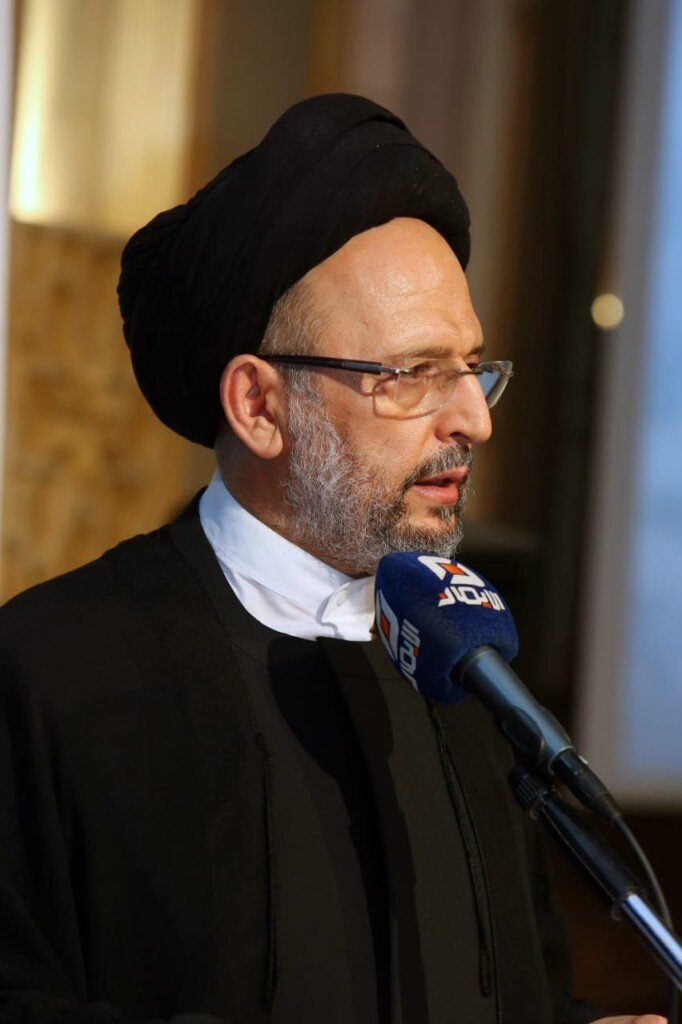
In closing, Allama Sayyed Ali Fadlallah delivered a speech in which he said: On this anniversary we did not want to renew grief - that grief which has not dimmed or been extinguished; we still live it burning since the Sayyed (may God be pleased with him) departed. For us the Sayyed was the father, the guide, the educator, the one who breathed life into us, and the patron of our ambitions, our hopes and our dreams..
He added: The Sayyed (may God be pleased with him) was a man of foresight and vision, because in his thought he was not an echo of the prevailing or the well-known, nor even of consensus. In his decisions and his stances he did not submit to the status quo, and he did not confine his thought to the time in which he lived. He was future-oriented, seeing in the future breadth and expanse, the object of his ambitions and the spring of his ideas - ideas that a backward reality might not be able to digest or bear..
He pointed to Sayyed Fadlallah's call (may God be pleased with him) not to be rigid in understanding the text and to develop the mechanisms of ijtihad, because he wanted religion to meet the human being's needs and requirements in this age, so that it would not be outside it and would not be seen by those committed to it as a burden and a problem upon them. The journey of exploring religion and coming to know it does not require replicating the understandings of past generations so much as it requires plumbing the depths of the text, its circumstances and the data of society and politics, and approaching this text in the new conditions.
He affirmed that ijtihad for the Sayyed (may God be pleased with him) was not a craft but a rational mode, a way of life and a deep thinking about the past for the sake of the future. He was likewise a pioneer when he worked on institutionalizing the work of good; this constituted a qualitative leap in approaching people's needs, for institutionalization came from his appreciation that goodness continues and is complemented and must not be hostage to individual initiatives that appear one day and are absent the next.
He stressed that Sayyed Fadlallah (may God be pleased with him) was a firefighter of tensions, an advocate of Islamic and national unity and of not yielding to those who spread anxieties among sects and denominations and among the countries of the Arab and Islamic world..
As for Palestine, it was for him the compass - a banner uniting the nation and bringing it together, and an expression of its values of justice and freedom for peoples, before which all small and marginal issues fall away. His words still echo: “I will not rest until Palestine returns to its people”.
As for Lebanon, he was visionary when he saw in it a banner of religious diversity and of the moral values that are the banner of all religions, and saw in it a starting point for dialogue - but he always warned against its being lost in sectarian labyrinths..
He saw that sectarianism is not a religion; it is a human grouping labelled with the name of religion that does not carry its values. It is Lebanon's incurable disease: from it the spark of threat to civil peace is kindled; from it the quota-sharing and the plundering of public money arise; behind it the corrupt leaders and their entourage shelter from punishment; and because of it alliances with the outside are formed at the homeland's expense. In the face of that he wanted to humanize the homeland, so that it might live humanity in the relations of its people and its sects with one another. He therefore called for a state of citizenship, the state of the human being, at the expense of the sectarian system that was a custom and then became a law. Sayyed Fadlallah spoke a great deal of the necessity of confronting the corruption that hides behind sectarian and denominational slogans and benefits from their atmosphere, until corruption almost turned into a general culture - exactly as Imam Ali (a.s.) indicated when he held that “the corruption of the common people comes from the corruption of the elite”.
He went on: He feared greatly for Lebanon's future and warned that the corrupt might succeed in confronting any reform movement… He said: “Every movement to confront internal corruption will not be granted success if conditions remain as they are in this tribal, denominational and sectarian fever, whose protection and patronage many watch over at the expense of the country, its social and political security and the future of its generations”..
And he was a pioneer when he wanted Lebanon to be strong. He therefore supported the resistance when it bore its responsibility in confronting the occupation and formed a landmark of strength in this country and a pillar of Lebanese society, protecting it from Zionist attacks and constituting the balance of terror that prevented and prevents the enemy from committing new adventures in Lebanon…
He concluded: Sayyed Fadlallah made a future for us, so let us work to make a future for the coming generations - as he said: “I want you not to be absorbed in the margins of the present or in its trivialities, but to be forward-looking”..
On this day we all stand to pledge to you what you called us to, and we will not fail you whatever the difficulties and challenges; and under the shade of your thought and your spirit we will be able to overcome them..