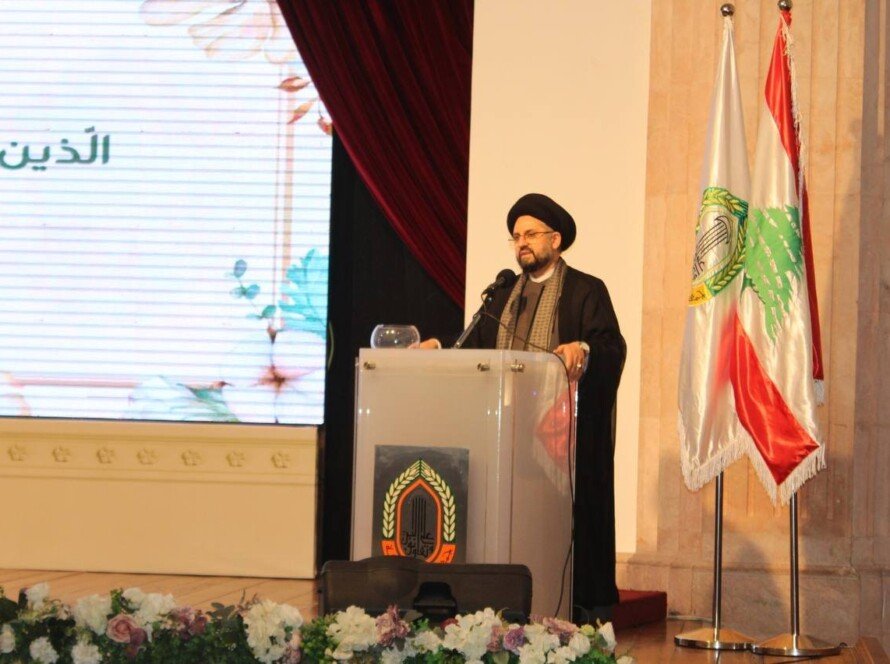
The president of Al-Mabarrat Charitable Association Allama Sayyed Ali Fadlallah called on those working at Al-Mabarrat for the banner of righteousness (birr) to be their goal - which means that we stand with the truth even at our own expense, that we stand against injustice even if it comes from the closest people to us, that we extend bridges of communication with all people and that we live with the points of encounter. His Eminence's words came during Al-Mabarrat's twenty-seventh educational conference under the title “Integrated Care: Embrace and Empowerment”, in the Lady Al-Zahraa hall in Haret Hreik, in the presence of educational, social, academic, religious, municipal and cultural figures, and a gathering of the educators of Al-Mabarrat's institutions in Lebanon.
His Eminence said at the opening ceremony, presented by the conference's secretary Ayat Nour Eddine: “We took this choice, dear ones, when we gathered under a great banner, the banner of righteousness (birr) - for we are Al-Mabarrat Association, and this means that it is the maker of righteousness: it takes the initiative towards it and does not wait for others to do it. We have carried this principle and will continue to carry it together. Righteousness means expansiveness in goodness, in giving, in generosity; and righteousness does not stop at the limits of material giving but includes the affectionate, tender, gentle word, the delicate word, the finest word, the rational, wise word that does not provoke the other.”
He added: “Righteousness is righteousness in conduct: that you be of good character, that you repel the bad deed with the good one; that you stand with the truth even at your own expense, and stand against injustice even if it comes from the closest people to you; that you communicate by extending bridges of communication with all people; that you always live with the points of encounter; that you be humble towards people however high your standing and your position; and that you be zealous for people's interests.”
He continued: “This choice is what Al-Mabarrat Charitable Association made at the level of the institutions when it set out. Its choice was to be present wherever there is need.. So it was present in the fields of orphans, in the fields of disability, in health, in the care of the elderly, in learning and education, in social services, in the spiritual and developmental field, and in the encounter of religions and denominations.”
He stressed that “righteousness is what should govern our relationship with those who benefit from these institutions, whether they are orphans, social cases, people with disabilities, the elderly, the sick, students, or those active in cultural, outreach and guidance work, or families and parents: that we respect them, that we offer them the best we have, that we offer them before all else our love, our smile, our care for them and our good character - and after that that we offer them knowledge and learning, that we fill their hearts with it.”
He concluded: “We will be equal to the responsibility by diagnosing well the needs of our people, in this age in particular, where the challenges are great amid the great flood of social media, from which good may come, but through which the means of deviation have become available, reaching every hand and entering every home.”
The adviser to the Minister of Education
The conference featured a speech by the adviser Anwar Dawi representing the Minister of Education Mr. Marwan Hamadeh, which read: “Within the expanses of this place fragrant with the scent of faith, giving and openness, you imagine yourself in an oasis. Here is a place of worship that guides you to God without intermediaries, while the country teems with intermediaries who claim to connect you with the Creator and most of whom, even if they pray, do not truly pray. And here are tables spread for those hungry for knowledge and vessels filled for those thirsty for learning, while the country reeks of corruption, waste and the theft of the morsel of bread from the mouths of the poor and the hungry. And here are open minds and open hearts that believe in dialogue, tolerance and moderation, while the fanaticisms cover the homeland's expanse with their black smoke and the exploiting sectarians raise their heads once again like snakes peering from their holes awaiting new prey. This national, value-based and faith-based oasis is the oasis of Al-Mabarrat Charitable Association - the oasis of goodness, knowledge, sacrifice and blessing; the oasis of the open-minded believers; the oasis of the master of knowledge, sacrifice, faith and openness, His Eminence Allama Sayyed Mohammad Hussein Fadlallah.
He added: “The idea of your conference this year on integrated care is but a sincere expression of this orientation - you who have worked to create equal opportunities for children, among them those with special needs, through inclusive teaching or through institutions dedicated to them; who have set a special programme for developing the capacities and skills of juveniles, especially those at risk of deviation, and for correcting their behaviour so as to facilitate their social integration. Most importantly, you arm the young generations with firm faith, open to everyone including the different other, stressing the principle of dialogue, without which no homeland will remain to us.”
The Director General of Al-Mabarrat
The Director General of Al-Mabarrat Charitable Association Dr. Mohammad Baqer Fadlallah delivered a speech which read: “Al-Mabarrat's schools and its care institutions will continue to carry out their educational and humanitarian mission despite all the social and economic difficulties and the challenges facing these non-profit institutions, so that they are not forced to close their doors or some of their doors. We are still addressing, with the union of educational institutions, the repercussions of law 46/2017, in addition to the rise in prices, which is reflected on the institutions as on all people. As educational and social institutions in Lebanon we consider that what brings us together is one vessel; we work together in order to protect the human being in this homeland, far from political, sectarian and factional calculations.”
He pointed to the successes at the level of the official certificates, saying: “Last year was full of achievements at the level of the official certificates as in every year: 575 graduates, male and female, graduated in the secondary certificates with 365 distinctions and ten first places at the level of Lebanon; 1,351 pupils passed the intermediate certificates with 595 distinctions and one first place at the level of Lebanon, as well as first places at the level of the governorates; and 394 passed the vocational certificates, among them 13 first places in several specializations (mechanics, hospitality, air conditioning, electronics) - noting the success of 98 educational inclusion pupils.”
He spoke of integrated care for orphans, saying: “It is a fixed course in Al-Mabarrat's approach, where the care institutions work to guarantee their rights through a balanced care in faith, thought, society, body, emotion and morals, by way of educational programmes, activities and skill acquisition, and getting to know life's issues through an integrated family system together with the teaching institutions, with a coordinating cooperation emerging from committees of the schools and the care Mabarras to provide quality teaching for the orphans, the difficult cases, people with disabilities and those with special needs.”
He referred to the preparation of the draft document of general policies at Al-Mabarrat, noting that it “contains policies such as the selection of leaders, openness to the other in the homeland and the world, complementarity among the association's institutions, continuous development of human resources, self-evaluation and continuous development, the participatory approach, adopting the quality system in work, funding and spending, managing risks and crises, media, and preserving information security”.
He affirmed the importance of twenty-first century learning skills, saying: “We must re-affirm that this theme be given attention by defining a practical framework that ensures the introduction of these skills into the teaching curricula as into the educational and care programmes, monitoring the extent of their application and then assessing the extent of learners' and children's mastery of these skills, in a way that contributes to the effectiveness of learning and growth and to possessing the necessary critical thinking, creativity, cooperation and communication skills and others.”
He stressed the adoption of social-emotional learning skills, saying: “It has become necessary to take account of social-emotional learning skills in all the curricula of the teaching subjects in a way suited to each subject's contexts. We therefore urge the institutions' administrations to include these skills as an essential factor within the plan of the job position and to introduce them into the teaching and care programmes and to train on them, since studies affirm that these skills have an effect on integrated development, including academic attainment and thinking skills.”
He spoke of the relationship with the “Educational Centre for Research and Development”, saying: “Al-Mabarrat's schools are still pioneering in keeping pace with what is new regarding the Educational Centre for Research and Development and in contributing to the proceedings of the new curricula, where they had representatives and participations in all the workshops and reflection circles relating to issuing the document on the traits of the Lebanese learner, the new educational advancement plan, the specifications of the official examinations and others. The working papers presented by Al-Mabarrat's representatives made effective contributions to the final documents that were issued.” He added: “This year an experimental application will begin of the STEM curriculum (integrative teaching of the sciences) in technology, physics and mathematics for the secondary stage, which USAL University has prepared.”
On the inclusion programme at Al-Mabarrat he said: “With the enrolment of kinds of difficult cases that require the availability of quality services suited to the needs, and with the increasing challenges of the economic situation and the material burdens on the institutions' continuation, the administrations must study the reality of each institution and devise new ways and methods of working and rationalize spending in order to preserve the continuation of these programmes with the required quality, while easing the material burdens relating to the beneficiaries' difficult economic circumstances.”
He turned to the role USAL University plays educationally, saying: “The university has been an extension of the experience of Al-Mabarrat's educational and social institutions, which hold within them expertise and experiences that are the fruit of forty years of distinction, quality and complementarity. The university, like Al-Mabarrat's institutions, has been able - through its academic environment, in conformity at the level of academic accreditation criteria, and through its quality capacity to keep pace with educational, scientific and technological developments - to contribute effectively to spreading scientific knowledge and to responding to the accelerating developments in education and teaching, and consequently has offered a bright picture at the level of its outputs and the competencies and skills of its graduates, which has enabled them to enter the labour market easily.”
He praised the role of those who worked on completing the excellence guide for teaching institutions and the excellence guide for care institutions, and said: “The intellectual property right for this pioneering and first achievement has been registered at the Ministry of Economy in Lebanon.. This constitutes a reference framework for any institution wishing to benefit from Al-Mabarrat's experience in founding teaching or care institutions in agreement with the association, and this guide will be adopted in developing the process of central auditing.”
Discussion panel
After that Al-Mabarrat's artistic troupe presented an anthem inspired by the occasion, followed by a filmed report on vocational care at Al-Mabarrat, then a discussion panel on “Integrated Care: The Vision and the Challenges”, moderated by Ms. Riva Al-Sayed Qassem, in which the director general of the Islamic Orphanage Dr. Khaled Kabbani took part, along with the specialist in clinical psychology and psychological disorders Dr. Leila Dirani and the general religious supervisor at Al-Mabarrat Sayyed Dr. Jaafar Fadlallah.”
Dr. Leila Dirani gave an intervention at the panel in which she set out the importance of the educational relationship between the educator and the pupil in achieving a balanced development for the pupil in which intelligence and educational and social attainments are in harmony. She explained the foundations governing this relationship, beginning with setting general rules for the classroom with an awareness of the pupils' individual and group behaviour, and stressing that education is accompanied by the correction of error and is not a place for condemning the individual.
For his part Dr. Khaled Kabbani spoke of the concept of comprehensive care, from serving the individual to meeting all their needs. Noting the state's neglect in activating the charters relating to children's rights and the decline in financial allocations and in the mechanisms created because of the present economic crises, he said: “We face obstacles represented by dealing with some indifferent families of those we help and with some mistaken behaviour from some orphans, and by the insufficient orientation towards educational specializations. It is also difficult to secure the material and human resources in the field of care, in a challenge to continue carrying out its care duties and its educational and environmental role.”
As for Sayyed Dr. Jaafar Fadlallah, he gave an intervention that discussed the prevailing idea that sees religious care as a field separate from the other teaching and educational fields. In his intervention he sought to present the religious texts as evidence of a religious vision resting on the principle of integrated care, by addressing all of a person's dimensions interactively so that no dimension is separated from another - a vision that also places the whole teaching curriculum at the core of the religious orientation of care.
It should be noted that the conference featured 19 workshops on newly emerging educational issues over the course of a week at Al-Mabarrat's various institutions.