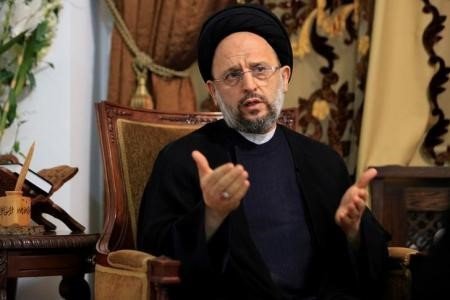
Al-Mabarrat Charitable Association held its annual iftar banquet at Al-Rahma High School in Kfarjouz - Nabatieh, in the presence of social, party, educational and municipal figures and religious scholars, and a large crowd of guests from most of the districts of the south.
The ceremony opened with a welcoming speech by the director of relations and sponsorship at Al-Mabarrat Jaafar Akil, in which he thanked those present and the supporters of the continuity of Al-Mabarrat's journey.
Fadlallah
Then came a speech by the president of Al-Mabarrat Charitable Association Sayyed Ali Fadlallah, in which he said: “Among the most important blessings we enjoy in this blessed month are meetings such as these, when we gather with all our diversity at the level of religions, denominations, political positions or cultures - so that we may meet around the human being, by working to ease his suffering, his pains and his frustrations, so that he may feel safety, hope and the ability to fulfil his wishes and his ambitions.”
He added: “The month that is ascribed to God must be a month for people to open up to one another. It is a month for meeting around goodness, love and humanity. For it is not permissible before God that a person should be a believer while he is closed in upon himself or does not feel the pains of the people around him. A believer is not a believer until he loves for his brother what he loves for himself; and a person does not reach the summit in worship unless he becomes one who walks in the fulfilment of people's needs.”
He continued: “Among the most important aims of fasting - which is an obligation upon people in all the heavenly religions - is that the rich should feel the pains of the poor, so that they may feel with them, and so that this feeling may drive them to help them in meeting their needs and in solving their problems. Our problem is that many of those in positions of responsibility do not move to solve people's problems, because they do not live them. And when we feel the value of the human being, our meetings will not be confined to the month of Ramadan and to the limits of what we meet over; rather they will be comprehensive meetings extending through time.”
He went on: “It is the right of our human being upon us, especially if we are in positions of responsibility, that he should live as others live, that he should enjoy full care and dignity as others enjoy them, and that he should have the opportunities of knowledge, development and success as others have them. We lack neither money nor minds nor capacities, and we do not lack the values that impel us to that. But what we lack is planning. What we lack is liberation from selfishness and narrow interests, and from the personal, sectarian and denominational calculations that feed on our reality. What we lack is a sincere will to confront the corruption we have become addicted to and which squanders many of our capacities. What we lack - and what we see as fundamental - is to feel the pains of these people, to listen to their groans and their suffering, and to respond to their aspirations.”
Fadlallah said: “When we stripped away all the calculations that separated us, each of us returned to his humanity and we changed our reality. Sufficient witness to that is this land we stand upon. When our efforts were united as army, people and resistance, and we fused together at the level of the homeland with everyone taking part with their effort and offering what they had, we were able to liberate our land and to drive out an enemy that armies and forces possessing more than we possess in money, materiel and means had failed to confront. As for the other witness to that, it is these institutions and all similar institutions, which were built to continue by the grace of God first, and through the joining of the efforts of goodness. We are able to build and to give more if we cooperate and decide to emerge from our individuality to the mentality of the nation, so that we support one another, strengthen one another, and keep all the devils of fanaticisms and sensitivities away from our reality.”
He added: “The present stage needs a deepening of meeting in all its forms at the various levels and in all positions, so as to confront the strifes that are meant to tamper with our reality, to enter all our arenas, to bring down all the positions of strength in us and to make us lose everything we have gained and acquired. They will never be to our account, and there will be no winner in them, for everyone is a loser in strife, and whoever thinks he will gain through it is deluded. Those who will be victorious are those who come to us after we have grown weary and been covered with wounds - as is the reality in all the wars and tensions taking place in Syria, Yemen, Iraq and Libya, after which come the states of decision in the world to divide the cheese among themselves, and with them the Zionist entity through its alliances, which have now become with East and West, so as to draw borders that match their interests and the keeping of their upper hand - not the hand of the peoples of this region and their choices.”
He continued: “The ability to repel the plotting of those who spread strife lies in our being aware, so that we allow no one to manipulate us - when we summon up our uniting values and principles; when we affirm that what we meet over is great, and is more than what we differ over; when we cease summoning up all the rancours of the history we have become addicted to and the rancours of the present that we produce, through our words, our deeds and our slogans that we mean to provoke the other's feelings rather than to move his mind; and when we transcend our narrow interests, so that our slogan is always what Imam Ali (peace be upon him) said, ‘I shall be at peace so long as the affairs of the Muslims are at peace'; and when each of us considers that his strength will not be attained by weakening others, but by preserving their strength; when the language of dialogue is stronger than the language of weapons, and kindness stronger than violence; and when we do not lose sight of the aims and swap around the loved ones and the enemies.”
He went on: “We ought to take a lesson from our history, when we were fighting one another in the civil war, and each party thought that it was thereby establishing its existence and protecting itself, and perhaps expanding its influence - and it became clear to us that we were thereby building palaces for others on the ruins of our houses and the destruction of our reality. And when they got what they wanted, the war quieted down and the settlements were imposed. In this region we have become the ball tossed about by the great powers, and unfortunately we are the players. Deliverance from the present impasse raging in the region will not come through the continued haemorrhage of blood and destruction, so much as through setting the wheel of dialogue in motion among the states influential in these wars that are devouring everyone.”
He said: “The internal forces must be keen to facilitate the opportunities that lead to building the state of the human being, in which a person feels his humanity and his dignity, whatever his sect, his denomination or his political position; and to restore to the religions their tolerance, their humanity and their mercy, in the face of those who want to exploit these religions to carry out their projects, strengthen their entities and consolidate their influence. This is the responsibility of the religious authorities, especially the Islamic ones with their various denominations: that the Islamic denominations should stand in one rank to confront this terrorism that has distorted Islam and struck at the interests of the Muslims, and which will not be to the account of this denomination or that, even if it uses denominational slogans.”
He added: “All efforts must be mobilized to buttress the country's political, economic and security foundations, so as to confront the challenges facing it: first from the Zionist enemy, which we have forgotten while it has not forgotten us and is still awaiting the opportune moment to pounce on us; and from terrorism in all its shades, which strikes in every direction; or from the American and non-American financial sanctions, as well as what is going on in the surroundings around us. This can only be done through internal cohesion and through strengthening the climates of dialogue at every level, especially the rebuilding of the state after treating the paralysis that has come to affect all the institutions.”
He held that “the fundamental road to treating many of our problems is in returning to our humanity”, and said: Imam Ali said: “Fear God with regard to His servants and His lands, for you are responsible even for the plots of land and the beasts.”
He concluded: “I call for holding more meetings in which we together renew the covenant to carry this human trust, and together complete the journey that preserves these institutions, and together bear the responsibility of developing them, preserving them and consolidating them, so that they may give more - and we want this giving to be far from the borders and the barriers that our reality collides with.”