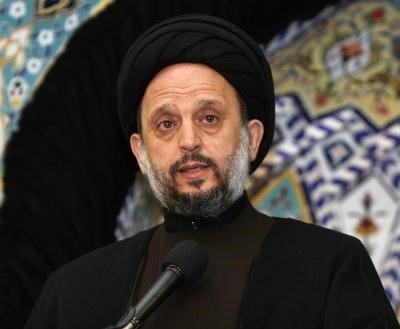
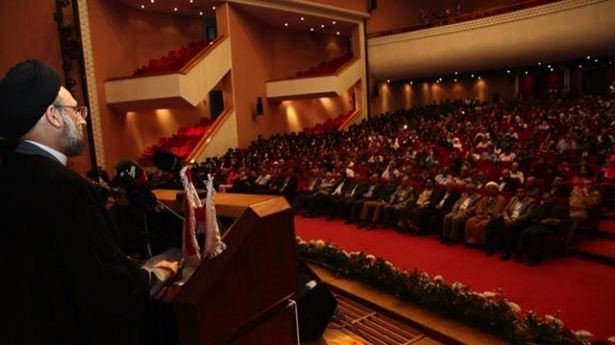
Several months ago, Allama Sayyed Ali Fadlallah, in cooperation with about 300 Lebanese and Arab figures (Islamic, Christian and secular), launched the «Forum of Religions and Cultures for Development and Dialogue», with the aim of strengthening dialogue, confronting religious violence and extremism, and building a new culture based on acceptance of the other and on pluralism.
The «Forum» has succeeded in establishing itself as a body, but it has not succeeded in breaking through the wall of fanaticisms and in building a real dialogue, despite the encouragement its members have heard from spiritual and political leaderships. Despite that, the Forum's members have insisted on continuing, aware that they are digging into the rock of rigid ideas, in the hope that they may be able to plant the ideas of dialogue in it.
In this context the «Forum» launches tomorrow a new initiative to support civil peace and dialogue, on the eve of the fourth anniversary of the departure of the Marja' Sayyed Mohammad Hussein Fadlallah, who left an intellectual and jurisprudential heritage rich in the culture of moderation, openness, dialogue and tolerance, which his son Sayyed Ali Fadlallah has translated in several fields, among them the founding of the «Forum of Religions and Cultures for Development and Dialogue». This came as an expression of a group of figures' sense of the anxiety resulting from the rising of walls and the blocking of the horizons of dialogue: «and so the meeting came at that moment when denominational and sectarian fanaticism was almost devouring everything, whether in Lebanon or in Syria and Iraq. The concern was to raise our voice, and to strive within the limits of our capacities and the circumstances available to extinguish the fires of rancour, to cast aside fanaticism, and to raise the questions and ideas that shake the foundations of the religious and moral legitimacy of this blind religious violence, unrestrained by any controls, which respects no sanctity in a mosque, a church or a street teeming with safe inhabitants», in the words of Sayyed Ali Fadlallah.
Fadlallah tells «Al-Safir», on the eve of the «Forum»'s convening, that the founding document of the «Forum» affirmed the keenness to strengthen understanding among the religious, intellectual, cultural and social components, by opening the field to the broadest dialogue at the religious-secular level, at the Islamic-Christian level and at the Islamic-Islamic level, and by arriving at unifying headings embodied in joint collective work. «Perhaps the priorities at this stage require that the endeavour should focus on strengthening the relationship among religions at the general religious level, and the relationship among denominations at the general Islamic level, in a way that prepares for movements and positions that urge the casting aside of strifes in all their denominational, sectarian and political forms.»
Fadlallah holds that the most important thing is «to affirm that all the forms of extremism, fanaticism and excess that prevail are not the product of our religion and our culture. This requires a scientific and moral approach to the fanatical religious discourse that distorts the image of religion - the bearer of the finest human values and ideals - that threatens coexistence with explosion and that pushes our countries towards partition, thereby fulfilling the wish of the Zionist entity; an approach that reveals the flimsy foundations on which the discourse of fanaticism (to whatever religion or denomination it belongs) relies to prove its religious and faith-based legitimacy.»
«The Forum's aims»
At the national level, Fadlallah stresses that among the Forum's aims is «affirming coexistence and attending to civil peace on the basis of citizenship founded on the headings of dignity, justice and equality».
Fadlallah affirms that the «Forum» did not set out from a void: «rather there is a dialogical journey that has taken more than one direction, and we are supplying this journey with new energies, which may carry a deeper and more comprehensive approach to our religious, denominational and civilizational crises, and which may take greater account of the state of sectarian, denominational and scholarly diversity.»
Fadlallah points out that «what worries us most at this stage, and what comes at the head of our priorities, is addressing the distortion that has afflicted the image of Islam over the last two years and trying to correct it, and mobilizing all energies and directing them to practise responsible intellectual and scientific criticism so as to dismantle the link between Islam and blind violence, the exclusion of the other, and the threatening of coexistence, internal peace and the unity of society and the nation - as well as shedding light on international schemes that bear responsibility for creating this link, since the conclusive facts point to an active role of intelligence and international agencies that embraced this violence attributed to Islam, supported it, patronized it, encouraged it and employed it, and facilitated for its members the conditions, the means and the freedom of movement, in the service of their political projects aimed at subjugating our homelands, weakening them and scattering their components on the one hand, and at harming Islam and the Muslims on the other.»
He adds: «Among our great concerns is to make use of every means to show Islam in its shining image; for by that we render the greatest services to the religions and to their value-based and human role, and to humanity in a future that is more just, more free and more liberated.»
A new initiative
On the new initiative the «Forum» will launch tomorrow under the title «Civil Peace and Strengthening the Language of Dialogue», Fadlallah says: «When the decision was taken to launch this initiative, the Lebanese scene was living in the shadow of acute security tensions, bloody suicide bombings, and sectarian and denominational congestion, to the point where we came to stand on the threshold of a civil war. In the shadow of this climate, a qualitative initiative was necessary that would gather under its banner the largest number of components of civil and religious society expressing the Lebanese concern, so as to launch a resounding cry against those who want to tamper with civil peace and to expose the homeland to the dangers of a new war whose only horizon is to deepen the impasse of internal division - like any civil war, in which none are victorious but the traders in wars and those who trade in what they call the interests of denominations and sects and their rights, even at the expense of the homeland's interests and its destiny.»
On the meeting that took place between the «Forum» and the «Muslim Scholars Authority», Fadlallah holds that the meeting between figures varied in their ideas and their positions is in itself an influential and useful matter with positive repercussions, whether at the level of the participants or at the popular level: «for close acquaintance removes many psychological barriers, and setting out in dialogue from a position of concern for the Islamic and national interest facilitates the process of arriving at a shared vision on more than one issue.»
Fadlallah believes that «the gulf between the differing parties on the Lebanese scene, which is connected with divergent readings of the present reality and the opposing positions that result from them, needs deep discussions and frank dialogues that may lead - if intentions are pure and if denominational interests in their narrow sense are transcended - to fundamental common denominators.» But he holds that «the matter needs time, patience and perseverance. While awaiting that, we see the necessity of all parties committing themselves to two fundamental principles without which civil peace is exposed to explosion and Islamic and national unity to danger: the first is not using violence in dealing with political disagreements, and the second is not using religion or denomination for mobilization and incitement in our internal conflicts.»
Fadlallah holds that «the Forum is one of the blessed fruits whose seed the late Marja' Mohammad Hussein Fadlallah sowed and whose ground he ploughed. Dialogue with the other was at the core of his intellectual method, and unity was his concern - he saw it not merely as a religious necessity but as an existential necessity connected with the future of Islam as a religion and a nation. Our late marja', with his penetrating vision, feared that the prevailing denominational mentality would lead to a sharp and great Islamic division, opening the doors to bloody conflicts of dire consequence; and he constantly warned of the hundred-year war within the Islamic milieu, which Henry Kissinger used to threaten the Muslims would take place.»
He adds: «Today we are in the greatest need of his path and his great dialogical and unifying legacy, especially in the shadow of an impasse we are living today and which it is feared may deepen in a way that prevents the possibility of transcending it for a long period, in the shadow of circumstances forming a new world that may cast us to the bottom of history.»
Fadlallah concludes: «What is required is carrying out genuine reviews at the level of our religious understanding and at the strategic and political level; moving as soon as possible to carry out genuine reconciliations at the Arab and Islamic level; and looking forward to building a real renaissance founded on renewal in thought, on comprehensive development in the economy, on unity within the framework of diversity, and on building strength in a world that respects none but the strong.»