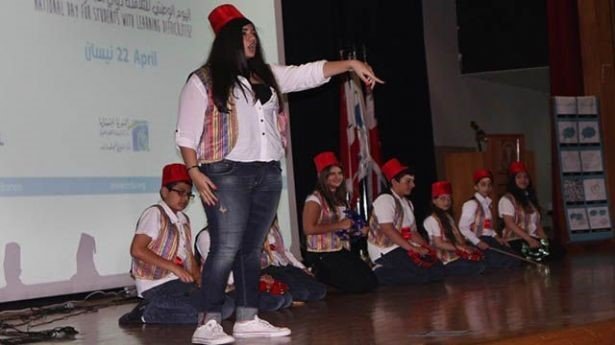
The activities of the National Day for Pupils with Learning Difficulties continue, aiming at extending bridges of communication and partnership between the state and its institutions, the parents and the school administrations, so as to create equal opportunities among pupils and their classmates who suffer learning difficulties.
Yesterday the demand was repeated for granting people with special needs their right to a dignified life, at the schools' celebration of the National Day at the Doctor's House, at the invitation of the British Council, the Centre for Educational Research and Development and the “SKILD” centre.
Moments later the celebration began, distinguished by tableaux by pupils shedding light on the culture of inclusion and its importance. To begin with, pupils from inclusive schools at Khaled Bin Al-Walid College, which belongs to the Makassed Association, came on. A picture of Agatha Christie, who sat on the throne of the British novel, appeared on a screen behind a pupil who said: “I am the novelist who occupied the world with the magic of her suspenseful novels. But you do not know that I, Agatha Christie, suffered from dysgraphia and difficulty in remembering numbers.” About the second figure, Albert Einstein, a pupil said: “I am Albert Einstein; I suffered difficulty in speech and it was suspected that I suffered symptoms of autism and dyslexia.” A third pupil said: “I am Napoleon Bonaparte the emperor; I had a mild degree of autism and ‘dyslexia'.” As for the last pupil, he introduced himself saying: “I am Leonardo da Vinci; I lived with ‘dyslexia'.”
An act of solidarity…
This tableau made the enthusiasm clear on the face of the president of the Makassed Association Amin Mohammad Al-Daouk, and it formed an important prelude to the celebration, which began with the showing of the film used in the awareness campaign, in which all the official and unofficial parties from among educators and institutions appear to indicate the culture of inclusion. For the occasion, the director of educational projects at the British Council Maysa Dawi delivered a speech in which she spoke about “equality of opportunity, which is the cornerstone of the Council's values”. She announced the Council's launch of an online study module on special needs so as to give educators the opportunity to deepen their understanding of the challenges facing pupils with learning difficulties.
As for Mrs Hiba Nachabi of Khaled Bin Al-Walid College, she demanded the achievement of education for all without discrimination in form and content. In form, she stressed first the existence of a law protecting the school and university right of people with special needs and providing work opportunities for them; second, the employment of this category in public jobs; and third, their enrolment in the official schools and the national university and work on fitting out the premises in a way that suits the requirements of this education and training the teaching staff at all stages. As for the content, she pointed to “the necessity of pressing ahead with the educational curricula prepared by the Educational Centre, allocating a budget to support these curricula, training the teachers, and creating a genuine partnership with the private schools”.
Pupils of inclusive schools at Al-Mabarrat returned to the stage to demand their right through a song, saying aloud: “Here where our Mabarrat is, we received a fine welcome from schools until they became with us despite the conditions, spreading knowledge that surrounds us with acceptance and with deeds…”
We returned to the educators' programme. After praising the role of teachers, parents and official professionals in attending to people with special needs, the secretary general of the Evangelical schools and general coordinator of the National Day Dr Nabil Kosta paused at the guide that brought together 70 schools qualified to receive people with special needs, hoping to develop it next year with a larger number of inclusive schools in Lebanon. The head of the programming and development unit at the Educational Centre Marta Thabet announced a joint programme to prepare trainers and teachers for learning difficulties in the official schools covering the Lebanese regions under the Centre's supervision. The secretary general of the Catholic schools Father Boutros Azar renewed his commitment to this cause, while emotion showed on the face of the president of the Educational Centre Dr Leila Maliha Fayyad, who asked those present to stand and applaud in tribute to their commitment.
The schools' tableaux followed one another, from the distinctive zajal about the cause by the pupils of the inclusive schools of the Evangelical Baptist School, to an exceptional model of inclusion and an approach to teaching geography by the Saint George school, and then the participation of pupils of inclusive schools at the Zahrat Al-Ihsan school in a song that said what was needed.
Finally we note that the British Council invited to Lebanon the two British experts Sally Farley and Mary Delaney to present their respective visions on people with special needs. In her speech Delaney focused on the most prominent sources of learning difficulties, which go back in most cases to shocks or to the loss of a loved one or to anxiety that impedes the process of acquiring information. Farley praised the role of the teacher, whose duty it is to notice any symptoms of learning difficulties in a pupil so as to intervene in his case at an early stage…