The University of Sciences and Arts in Lebanon organized a scientific-technological meeting, interspersed with workshops that aimed to “give students from different high schools basic skills in programming, qualify them to create applications for smartphones, and bring them up to move beyond the stage of technological consumption to the stage of production”.
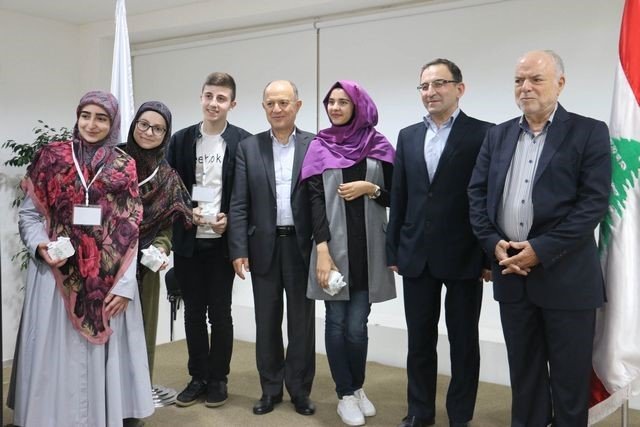
A statement from the university indicated that the students “competed in producing applications that address some of society's problems: students from Al-Rahma High School took third place for an application that determines the location of the people being called even if they do not answer, this application aiming to deal with emergency cases involving the sick, the elderly and children. Second place was taken by students from Al-Kawthar High School for an application to help people suffering from autism, and by students from Al-Jawad High School for an application that is a guide to the universities in Lebanon; while first place was taken by students from Al-Kawthar High School for an integrated application for school textbooks.”
The meeting included a ceremony attended by the director general of “Al-Mabarrat Charitable Association” Dr Mohammad Baqir Fadlallah and the director general of “the National Council for Sciences” Radwan Shoaib, along with representatives of the municipalities of the southern suburb and of companies working in the field of information technology, the principals of Al-Mabarrat schools and of various high schools, educational figures and students.
Mohammad Fadlallah
The ceremony began with the national anthem, followed by a short video presentation about the project, after which the university's president Dr Mohammad Reda Fadlallah spoke, welcoming those present and the participants and thanking them for “their cooperation and their great contribution to making the meeting's aims a success”, and noting “the university's concern with addressing contemporary technical issues connected with people's daily needs”.
He explained that “concern with the technical field is at the top of the priorities and choices of the University of Sciences and Arts in Lebanon, which seeks to spur its members towards the society of tomorrow with all its headings, its details, its complexities and its ambitions. Smartphones, with their complex technologies, have become inseparable from our daily activities, such that many people cannot part with their electronic devices for any length of time, and this is what makes approaching these applications a necessity.”
He pointed to “the importance of universities turning into centres of research and innovation that make them exporters of discoveries rather than consumers of them”. He said: “Experiences, contests and challenges have proved that our young people possess the ability to achieve wonderful innovative accomplishments through simple and modest tools and means, in the light of which they have obtained prizes and commendations, competing thereby with the greatest scientific centres.” He affirmed “the university's attention to scientific innovation, and its strenuous work to encourage every innovation that adds something new and to provide everything that facilitates the processes of excellence and creativity; for our young people lack neither intelligence, nor culture, nor readiness, nor the ability to become capable competitors. Our role is to provide the scientific environments that incubate and stimulate every emerging genius.”
Yasser Fadlallah
Then the project's supervisor, the head of the computer science department at the university Dr Yasser Fadlallah, spoke about “the importance of technological development and its role in the world of industry and its bearing on the various fields of life, such as education, communication, transport, work and social life”, presenting the stages of the development of the smartphone industry and its uses.
He announced “the keeping pace of the university's informatics specializations with this revolution”, and said: “Since informatics specializations in general and programming in particular are an integral part of the programmes taught at USAL, it was incumbent upon it to spread this knowledge in society; and so it launched the first competition for secondary students using the MIT App Inventor programme in 2011, with the aim of spurring the young elements to be producers in the world of mobile phone applications.”
Fadlallah summarized the project's aims as “arousing the creative side in the students and developing the fluency of their thinking and their logical sequencing, as well as strengthening their self-confidence”.
Salim
Then came a speech by the executive partner of “IDS Company” Sami Salim, in which he held that the cooperation between the company and the university “will contribute to strengthening the students' practical skills so that they become better suited to the requirements of the labour market”. He announced that “through this cooperation the company will try to work on developing the spirit of initiative among the university's students, and on spurring their productive spirit so that they become able to employ their capacities in the service of society”. He hoped “that the company will be able to invest in the university's outstanding students so as to bring up a category qualified for entrepreneurship”.
This was followed by the signing of a partnership and cooperation agreement between “IDS Company” and the university, with the aim of strengthening the students' skills so that they suit the labour market, making opportunities available to them to work within projects supervised by IDS Company, and sharing in the development of specialized educational curricula in the field of informatics.
In conclusion, certificates of appreciation were distributed to the training teachers and various prizes to the winning students.