The president of Al-Mabarrat Charitable Association, Allama Sayyed Ali Fadlallah, called on the Lebanese to: “build a homeland its people take pride in, with its distinctive wealth in the diversity of its sects and denominations which complement one another; a homeland they see as their choice, rather than loitering at the doors of embassies to leave it or emigrate from it to God's wide lands to work there or to obtain the requirements of a dignified life; a homeland we want to be protective of its people, free of corruption and waste; a homeland that adopts the language of dialogue and deepens encounter and the solving of problems”.
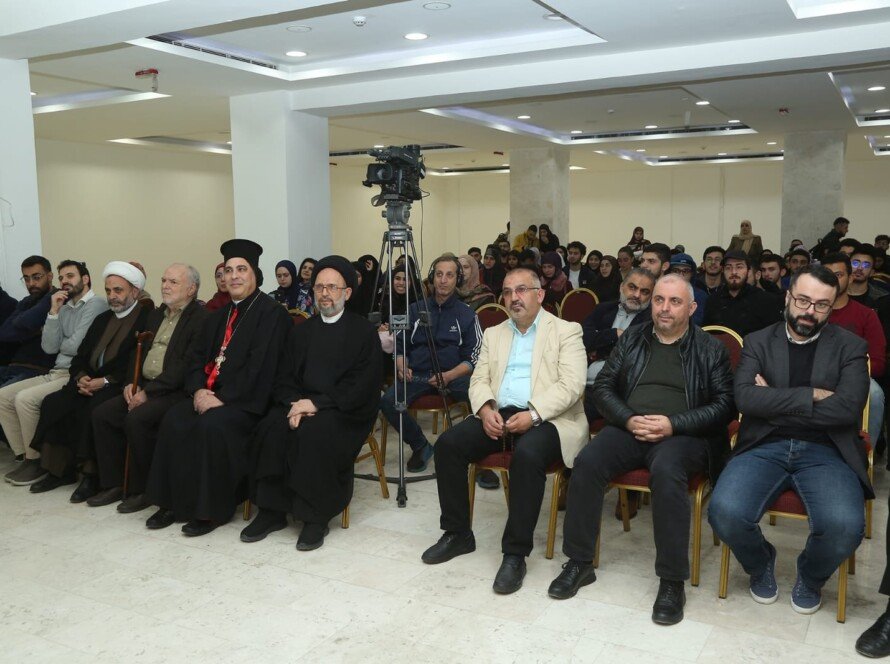
He said: “We still suffer from a difficult stage in which we have lost much - we have lost the wellbeing of this homeland, its resources and the resources of its people. So let us cooperate so as not to lose what remains, which is the pillar of this homeland; I mean teaching, education, and moral and faith-based formation. If we lose that, nothing will remain to us, for homelands that lose knowledge, morals, faith and education cannot stand and will not endure.” Allama Fadlallah's words came during the thirty-second educational conference of Al-Mabarrat Charitable Association, under the title “The Teacher, the Educator and the Administrator in the Age of Digitization: Features and Roles”, held in the Al-Zahraa hall at the Al-Imamain Al-Hasanain complex in Haret Hreik, under the patronage of Lebanon's Minister of Education and Higher Education Dr. Abbas Al-Halabi, represented by the Director General of Education Mr. Imad Al-Ashkar, and in the presence of the Director General of Al-Mabarrat Dr. Mohammad Baqer Fadlallah, representatives of educational institutions and cultural centres, mayors, educational, social, academic and religious figures, the directors of Al-Mabarrat's educational and care institutions, the directors of the departments and sections of the association's general administration, and a large gathering of Al-Mabarrat educators from the various institutions spread across Lebanon.
Director General of Education
The conference proceedings were presented by the director of Imam Ali High School Mr. Abbas Terhini, after which the Director General of Education Mr. Imad Al-Ashkar delivered the Minister of Education's speech, in which he said: “In normal circumstances the Ministry of Education and the private education institutions used to train the teachers, administrators and technicians working in schools, each according to their duties and to the development of teaching curricula and methods. In the present age, in which developments and educational approaches accelerate, digital skills have become an essential part of the skills a teacher must possess, and openness to the sea of information has become as frightening as it is useful. Hence the tasks of educators have become more complex, in terms of grasping what has come into learners' hands and how to choose between the curriculum material and the information available digitally in image, sound and video.”
He said: “Strengthening ethics within the educational family in all its components - the director, the teacher, the educator, the learner, the family and society - has become a natural matter, whether in terms of respecting sources of information or in terms of strengthening critical thinking and choosing what is useful while citing the source. I wanted to mention this by way of pointing to the growing tasks of educators, so that they may use everything technology offers in the service of the educational process, so that education, teaching and lifelong learning remain a path to constant development and to building a national character always eager for renewal and creativity.” Al-Ashkar addressed those present, saying: “We share with you, and with many distinguished educational institutions, in the workshop for renewing the educational curricula and the structure of education. With the Educational Centre for Research and Development and with partners and experts we have completed the national framework and the supporting policies, and in this great project there is clear good for the new roles required of the school director, the supervisor, the technician, the counsellor and the educational guide, given that all who take part in the school family share the responsibility of educating and teaching children and young people.” He concluded: “Yes, education is greater and wider than teaching, and the educator's responsibility is of the utmost importance. Hence we look forward to the conference's working papers, and to the interventions of educators and developers in the digital world in the service of education and teaching, so that we may benefit from the guidance, the conclusions and the recommendations, and raise the degree of readiness for the accelerating age, which has come to require of us a different preparedness and a greater awareness of the widening base of those concerned with the educational process that builds the character we aspire to.”
Director General of Al-Mabarrat
The Director General of Al-Mabarrat Dr. Mohammad Baqer Fadlallah then spoke, saying: “Under virtual dominance and deep transformations, our role as active educators stands out, driven by our responsibility towards our institutions and required to safeguard our social and religious values, which constitute the psychological, cognitive and cultural immunity of our children. It is a call we address to the teacher, the educator and the administrator, who form the third side of the triangle of teaching between the learner and learning - a call to acquire the desirable, appealing features that form the lifeline amid this vast throng, a lifeline for a generation entering the furnace of digital clamour. We note and stress that this is not a generalization, for what we are trying to shed light on is the necessity of rebuilding trust between the teacher, the educator and the administrator on one side, and the generation of learners of all abilities on the other, through the features and roles of this category of educators working in the educational sector.”
He added: “Young people's engagement, in the age of digitization, with the digital society and with social media has placed before them cultural models that cross geographical boundaries and transcend time and place, and has thus exposed them to universal cultural values that may conflict with, and not accord with, Al-Mabarrat's mission and vision. Here appear the features of the attentive teacher, the endearing educator and the decisive, aware administrator: the features of possessing the capacity for responsible dialogue and for attractive, productive communication; the features of one who has breadth of knowledge and the skills of speaking with learners and children; the features of one able to extend bridges of safety and affection; the features of the innovative leader who produces the tools of knowledge - for educational roles have gone beyond the teacher, the educator or the administrator being merely sources of information or instruction; their roles have come to be bound up with the good management of problematic discussions grounded in knowledge and religion. Everyone who occupies any educational position must now possess the features of listening and be described as an advisor, a believing and well-mannered guardian, and a cultured person who understands and is able to contain and support. The effort to restore the leading role entrusted to the teacher, the educator and the administrator is manifested in their being sources of safety for the learner, able to correct patterns of thinking and behaviour and to manage this digital space.” Dr. Fadlallah explained that “the ease of participating in the digital society and its means has enabled this generation, through browsing its contents, taking part in the topics circulating in it, and the spread of virtual discussion circles on all kinds of thorny subjects and the raising of questions about religion, its importance and its usefulness - it has enabled them to possess a double-edged critical sense. If we do not supply them with knowledge and means of persuasion, the void may lead to deviation, to atheism, or to a path of backwardness, fanaticism and superstition. Here it is fitting for the teacher, the educator and the administrator to intervene to confront the attempts at misinformation to which our young people are exposed, by offering convincing scientific answers that address the mind, appeal to its mechanisms and awaken the good motives latent in the innate nature upon which God created people.”
He held that “the generation of young people is the category that most uses social media sites, and these sites may reduce our roles as educators. We therefore call on the teacher, the educator and the administrator to take purposeful digital part in these spaces, to raise the values of justice and the rejection of racism, rancour and superstition, and to commit to posts that reflect the challenges of the stage and the awareness they require, without losing sight of the great strategic goals.” He spoke of highlights of the care work at Al-Mabarrat, noting “that care, ever since forty-five years ago when Al-Mabarrat began to embrace children among the orphans and the difficult social cases, has been a mission-driven, educational, cultural and comprehensively humane care. Along this road caravans of talents and cadres have graduated, adding to society's distinguished human capacities in education, thought and mission.” For the record, the number of children over successive years since the founding until today has exceeded 85,000, and the number of specialized graduates whom the care institutions embraced in various fields comes to about 12,630 university graduates.
He added: “Al-Mabarrat has resolved to be for everyone, but with the worsening of the economic crisis and its negative repercussions on the educational community, and the unprecedented rise in the numbers of orphans and difficult social cases coming to our care institutions, this has exceeded Al-Mabarrat's capacity to absorb all these numbers, bearing in mind that the number of orphans in the preceding year reached 4,800. In the midst of these difficult circumstances we strive with all we have for Al-Mabarrat's care institutions to continue embracing the rising numbers of orphans and caring for them according to the available absorptive capacity - but this has become tied to the resources available and to securing the necessary funding, which covers the cost of educational and daily-life care and the rising salaries of staff. We therefore raise our voice high for the care of orphans to be the responsibility of all of society, while affirming that Al-Mabarrat's care institutions will remain the best of homes and a safe refuge for the orphan.”
Fadlallah turned to the draft document of the Lebanese national framework for the general education curriculum, saying: “At the end of last year the document of the Lebanese national framework for the pre-university general education curriculum was issued, which is considered the basic foundation in the process of developing educational curricula in Lebanon, after nearly a quarter of a century since the adoption of the last curricula, and with the emergence of a number of criticisms directed at the way the framework was drawn up and the way the curricula are built. But we will continue to look positively on this beginning, which we hope will be a starting point for a comprehensive educational reform reaching policies, legislation and educational processes. Those in charge adopted the competency-based approach, which aims to develop transversal or cross-cutting competencies, and here we note that Al-Mabarrat has for years adopted competency-based teaching and competency-based assessment, especially in the first cycle (integrative education). We have also for years, in cooperation with the British Cultural Centre, incorporated deep learning skills (critical thinking, cooperation, problem solving, leadership, etc.) into the curricula, as they are considered part of the transversal competencies.”
He added: “Work continued through 2023 on adopting the papers supporting the national curriculum framework, in partnership with most components of the educational sector, which was represented on the committees through educational experts. For the record, Al-Mabarrat takes part in the coordination of the planning body and among the committee experts. We hope the preparation of the papers supporting the national curriculum framework will be completed quickly and that we will move to the stage of writing the curricula, while stressing that its work be kept away from political tugs-of-war and that these curricula focus on belonging to the homeland and cooperation among citizens, by way of institutional work and of dealing with contemporary issues without touching cultural and moral identity.”
The Director General of Al-Mabarrat called on those working in Al-Mabarrat's educational institutions “to remain abreast of developments in the curricula and to take part in preparing them. Al-Mabarrat's schools have a great store of work on effective systematic planning that focuses on building meaning, on noting the evidence of learning, and on effective learning plans” - affirming “a constant readiness to take part through experts at the level of all subjects and grades. What is required of the administrations, the supervision and the coordination is to keep up with developments seriously, to secure all the requirements needed to keep up with them, and to work on empowering and training the teaching and administrative bodies in all the requirements of this qualitative change in the curricula, while always insisting on preserving the system of values against which we are witnessing systematic wars to destroy it and to destroy what distinguishes these societies.”
He spoke of the development of textbook authorship at Al-Mabarrat, saying: “Al-Mabarrat believed in the importance of the textbook as a basic reference for learners, teachers and families, and as one of the basic inputs of the educational process. Al-Mabarrat's schools were therefore among those who took on the challenge of authoring textbooks from 2004, and with the development taking place in teaching technology and digital skills came the authoring of the computing book series alongside the STEM subject books, to give learners an opportunity to keep pace with the development taking place in the digital world.” He held that “the accumulation of educational and teaching experience, which is translated and bears fruit in the authoring of some books, increases our motivation to complete the journey”, calling on “all interested members of the educational family to contribute effectively, whether by taking part in the authoring committees or through qualitative additions to the books already authored, based on an aware critical reading”, and hoping “that the experience will be completed and take root so as to be reflected not only on Al-Mabarrat's schools but on everyone in the educational community who wishes to benefit from it, through the authoring of book series that match our ambition in the various teaching subjects.” He pointed to “the necessity of empowering people with special needs digitally”, saying: “The world is witnessing the peak of technological development (disruption), which is expected to continue and develop further over the coming decades. Institutions have found themselves face to face with highly advanced technologies, and people with special needs are an important part of the fabric of these institutions, being a productive and effective element if their capacities are well invested. Since Al-Mabarrat's schools and care institutions took upon themselves, proceeding from the thought of their founder the Marja (may God be pleased with him), to raise the levels of people with special needs and to find effective solutions for them, we believe in the ability of students with special needs to shape the future of the digital world just like their peers in the current generation, through a comprehensive understanding of the digital world that enables them to compete in public life and to have a voice in the future.”
Fadlallah called on “teachers and educators who examine individual differences and who kindle hope in the hearts of those who lag behind, to be patient, because students with disabilities face greater difficulty in digital learning, tied to the ability to pay attention and to plan student-centred learning, so that adaptation is based on students' individual learning needs; and to develop the analysis and management of information rather than merely storing it, by applying strategies that help engage students in the educational process through cooperative and experiential teaching, that strengthen personalized learning by addressing each student's individual needs, that make greater use of different means of confirming understanding instead of traditional assessment tools such as writing, and that broaden horizons for discovering and developing talent, given these students' capacity to carry out creative projects; and to involve them in a variety of virtual activities so they learn how to prioritize their time between virtual and in-person activities; to make students aware of safe digital use and of responsibility for actions online through knowing the consequences of misbehaviour in the virtual space; and to communicate regularly with families to show them how to follow up with their children in order to help develop digital skills.”
He pointed out that “the course of work in Al-Mabarrat's schools and institutes seeks first and foremost to achieve equality and fairness for all pupils whatever their needs, and to work on developing goals suited to each of them, including gifted and high-achieving pupils”, holding that “this category of pupils has special individual needs that should be taken into account in planning. For that reason Al-Mabarrat's schools launched, in 2016/2017 and in a systematic way, work with the gifted and high-achieving, followed by the definition of the theoretical reference framework and the preparation of a road map for working with them. This was accompanied by central training reaching a large number of those concerned in the schools, in addition to the formation of internal leadership committees to lead the work with this category of pupils. This is something that distinguishes Al-Mabarrat's schools and institutes from the rest of Lebanon's schools, as it is the only association in Lebanon that has delegated representatives to attend conferences on the gifted and high-achieving so as to bring the latest training and recent studies in this field to our institutions, and it is also represented by three members on the Arab Council for the Gifted and Talented - because our society needs creative, high-achieving people in knowledge and morals, with the capacity to lead, to influence and to bring about change, so that they may be the leaders of the future.”
Dr. Fadlallah stressed “the importance of continuing, in planning and in application, the programmes for the high-achieving and the distinguished in every institution, by carefully studying the indicators of giftedness for every pupil who shows in their performance a trait of the gifted, and by guiding them and developing their talent once it is detected. We call on everyone to strive seriously to begin the steps necessary to carry out the plans and programmes and to institutionalize them by setting clear, documented mechanisms open to assessment and continuous improvement, so that they may be adopted as basic programmes in our teaching curricula.”
He stressed attention to arts education, saying: “It is no secret to anyone how closely the arts are bound up with the refinement and civilization of peoples and the advancement of nations. The arts in an institution must not be a luxury, an element of entertainment and amusement, or material for filling idle hours; they are a pressing educational need. Studies have shown that including arts education in the curricula contributes to improving students' academic performance, since it forms a platform for students to express their ideas and feelings in different and innovative ways and opens before them horizons of experiment and exploration, which contributes to developing their creative capacities and stimulating them to think outside the box.”
He added: “Al-Mabarrat and its schools, with initiatives of varying scale, still encourage their pupils to present and employ their skills in a competitive atmosphere so as to show their capacities and creativity, through varied activities in art exhibitions, theatrical and musical activities, reading activities in several languages and story writing, and annual festivals such as the Spring Festival; and they have reaped many prizes - arriving at an aesthetic environment that is not confined to improving and beautifying the institution's facilities but extends to improving and beautifying the paths of mind, thought and creativity. The challenges facing the teacher, the educator and the administrator in the age of digitization must be accompanied by other challenges: the touches of spirit, emotion and feeling. Hence we affirm the importance of caring for a performing and visual arts culture open to the data of modernity and contemporary thought, which is considered a basic entry point to social-emotional growth and deep learning.”
He spoke of the course of development at the University of Sciences and Arts in Lebanon, which belongs to Al-Mabarrat, saying: “The university is continuing its progress amid the growing number of students coming to it, which will approach two thousand. Through its academic and administrative cadre it seeks to provide its students and graduates with all the knowledge and skills they need so that their profiles meet the requirements of the labour market, thereby becoming an added value that helps increase production and develop the quality of services in institutions.”
He added: “Quality in teaching places at the top of the university's priorities, and in all specializations, the graduation of students who are capable in a fast-changing digital world. On one hand it continuously develops all its academic programmes so that they contain learning outcomes that guarantee providing all students with the attainments that enable them to enter the digital world we live in, to benefit from it as much as possible and to avoid its dangers; on the other hand it strengthens the academic, administrative and student digital environment at the university. It has digitized all its services - the learning management system, the student information system, the administrative and academic operations system, the financial aid system and the library - and has strengthened the possibility of using digital scholarly and practical references, all with the aim of strengthening productivity in study, in attainment and in work.”
He continued: “The university completed its research work and worked on publishing many scholarly articles in the fields of cybersecurity, computing, communication and education. In cooperation with the Directorate of Education at Al-Mabarrat Charitable Association it also formed a research nucleus concerned with carrying out advanced scholarly research that benefits the educational institutions of Al-Mabarrat Charitable Association and the surrounding community. The university is currently working to broaden its fields in order to obtain licences for postgraduate studies and new specializations.”
The Director General of Al-Mabarrat pointed out that the association “worked on preparing the guide to educational and care institutional excellence, to be a guide, a compass and a help along its journey for all those working in its fields on the road to lasting excellence. It is the fruit of long stretches of time extending to hundreds of hours of work, with diligence, seriousness, energy, determination and limitless giving from the members of the central unit for continuous development and self-assessment, in order to advance Al-Mabarrat's journey. And when the excellence guide is mentioned we remember Hajjeh Rana Ismail on the first anniversary of her passing - that educational leader on whose brow this guide left a distinctive mark on Al-Mabarrat, who insisted on completing it with the working teams with precision and abundance, and who was a pioneer in conveying her message and her imprint, which enriched education and teaching at Al-Mabarrat as in the homeland.”
He stressed “giving the necessary importance to moving this achievement from the written theoretical framework to practical measures through a concrete, real experience, and that every institution should this year try out a criterion or an axis of the guide suited to its own components and its surrounding environment, working to achieve it through the institution's working team in coordination and follow-up with the central unit for continuous development and self-assessment - especially as modern educational trends rest on self-assessment.”
Allama Fadlallah
The president of Al-Mabarrat Charitable Association, Allama Sayyed Ali Fadlallah, then spoke, noting the title put forward for the conference, “which calls for studying the means that ensure broadening the circle of benefit from digitization and from what has come to be known as artificial intelligence at the teaching and educational level, and for removing any obstacles that might stand in the way of introducing it into the teaching and educational curricula and into administrative work in a systematic, considered way, in harmony with our values and principles, so that in this we are among those who take all of its positives and leave its negatives.” He said: “We see ourselves as concerned to enter the depths of this world, to be pioneers and partners in it, proceeding from our faith, which calls us to develop our capacities, our means and our competencies at the scholarly level and to take up everything new in the mechanisms of reaching it - not to rest content with a given state, and always to offer the best.”
He continued: “Naturally, taking up the digital world requires awareness, reflection and planning, which must be available to those who undertake work in the teaching, educational and administrative field - those whose role is no longer to secure information and present it, now that information is available on an enormous, unprecedented scale and with high-quality audio and visual illustration. Rather their role will be to guide towards the information, to improve how it is taken, how it is applied and how it is made to flow in the school and the university or in workplaces, and to motivate the seeking of knowledge and learning and make recipients feel its importance as a duty rather than a choice, instead of the retreat we may be witnessing in this regard; and to warn students against becoming captives of this world and dependent on it, neither thinking nor taking initiative, surrendering to it and taking it as a given, so that they receive information from behind the screen as rigid moulds without reflection or awareness of what they receive, neither verifying nor examining it - rather they should be aware of how to deal with it and how to guard against any negatives that may arise from it.”
He added: “Our wager is on our teachers, our educators and our administrators to keep pace with this development and with how to deal with it, and we are with you in bearing this responsibility. I know the heavy burdens each one of you carries in this difficult stage, in which a person has become preoccupied with securing the requirements of their living, their medicine and their means of treatment, for themselves and for those they support. But I am confident that in spite of all this you have risen above all these circumstances; you bore the responsibility before and were worthy of bearing it, and today you will rise above it and will offer everything new.”
He addressed those working at Al-Mabarrat, saying: “I must thank you, appreciate you and bow before you for your steadfastness and your continuing on this journey despite the hardship you live and the difficulties you have passed and are still passing through. I also thank all those who were with us in the previous stages - among them those who departed to be near God after fulfilling their mission sincerely, and those who left us under the weight of overwhelming and pressing circumstances, whom we hope will return to the embrace of our institutions.” He thanked “those who have recently joined Al-Mabarrat's journey”, saying: “I am confident that those who have joined us do not aim thereby at obtaining money that we pay more than others, or at material or moral gain, but rather for the mission-driven purpose they believe in.”
He added: “We promise you, as we were keen to do before, to stand with you as much as we can, to be always faithful to you, despite all the circumstances still buffeting these institutions and others in this country; to work on reconsidering the material means and available resources so as to provide assistance that takes into account any changes at the economic level - because we are concerned for you, for your parents, for your families and for your children whom you care for, help and support. And here we renew what we have said: if we strive to lighten the burden on people, on orphans, on social cases and on people with disabilities, we are also concerned for those who work with us.” He pointed out “that we still suffer from a difficult stage in which we have lost much - we have lost the wellbeing of this homeland, its resources and the resources of its people. So let us cooperate so as not to lose what remains, which is the pillar of this homeland; I mean teaching, education, and moral and faith-based formation. If we lose that, nothing will remain to us, for homelands that lose knowledge, morals, faith and education cannot stand and will not endure.”
He said: “From our position we will continue to bear the responsibility, and in the light of the energies and means we possess we will work to ease the suffering our reality lives through. At the same time we will exert the effort to build the generations whose responsibility we have shouldered; we will develop in them a sense of order and discipline in a reality in which everything calls to disorder; we will provide all the incentives that draw them towards knowledge; and we will employ the newest and best methods of education to root in them commitment at the moral and faith level, amid challenges that work to undermine the foundations of values and morals in our society - challenges helped along by media outlets and social media sites, as well as by parents being too preoccupied to play their role.”
He continued: “We are called to build a homeland that we want to be one its people take pride in, with its wealth, distinguished by the diversity of its sects and denominations which complement one another; a homeland they see as their choice, rather than loitering at the doors of embassies to leave it or emigrate from it to God's wide lands to work there or to obtain the requirements of a dignified life; a homeland we want to be protective of its people, free of corruption and waste; a homeland that adopts the language of dialogue so as to deepen encounter, to solve problems and to reach the constitutional deadlines - not the language of rupture and of provocative, tension-raising discourse, whereby we end up with someone saying to us: our Lebanon is ours and your Lebanon is yours.”
He concluded: “We are here to affirm that despite all the circumstances we live through and the difficulties the homeland suffers, which invite us to retreat and pull back or to freeze everything we are doing, we have come to affirm that we are equal to the trust we have shouldered before God and before our people, and that we will exert every effort to discharge that trust. But this will not happen through individual effort; it will happen through cooperation and complementarity with all the teaching and educational institutions in this country, especially those that live the responsibility of building the generations and raising them up academically and educationally - cooperation in the fields of exchanging expertise and experience, so that we may bring the educational and teaching process to its ideal form. Great tasks await us in achieving these aspirations, concerning the necessity of working to develop teaching curricula and their methods in education and administration, in the context of striving with all the components of this homeland to bring about scholarly and educational complementarity.”
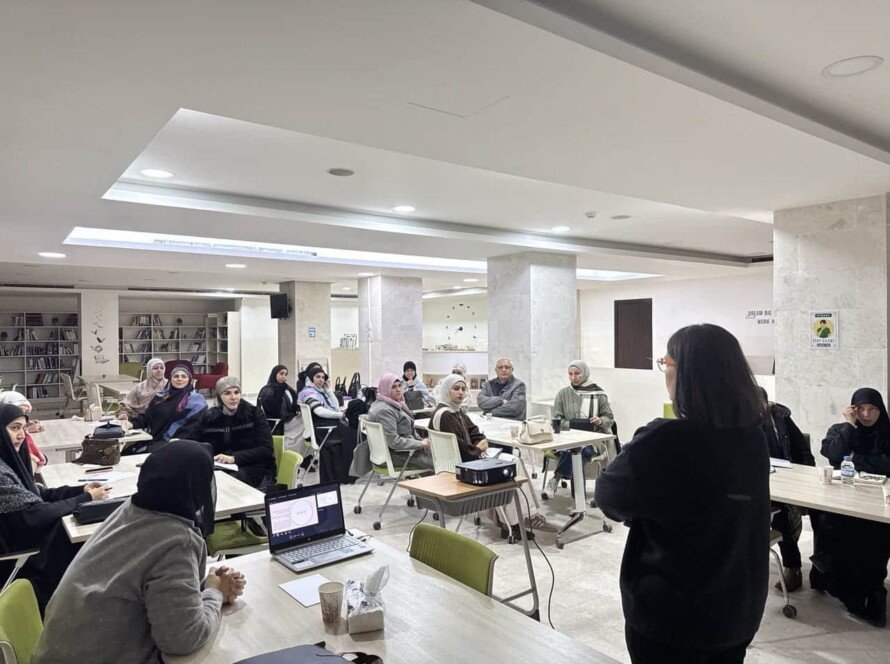
The conference closed with a scholarly panel entitled “The Teacher, the Educator and the Administrator in the Age of Digitization: Constants and Variables”, in which the sociology researcher Dr. Talal Atrissi spoke, along with the professor of educational psychology at the Lebanese University Dr. Ghada Asaad, the head of the computer science department at USAL Dr. Yasser Fadlallah, and the professor of psychiatry at the American University Dr. Leila Aqouri Dirani via a recorded intervention. The panel was moderated by the conference secretary at Al-Mabarrat Ayat Nour Eddine, who said: “This conference is the product of immense efforts running from the beginning of the year (preparation for the conference begins in the first month of every year) in committees and teams - starting with the central conference committee, to the nucleus teams responsible for preparing the workshops, to the team of trainers, to the hosts (a host is an expert in training who takes part in the training in order to give feedback against defined criteria), to the logistical teams in every institution, and on to the logistical teams for the conference's main day.”
She added: “The conference workshops are not assembled workshops but constructed ones: they proceed from the conference's conceptual paper and draw their objectives from recent research papers and scholarly sources, taking into account the features of the Mabarrat person, derived from the mission, the vision and the objectives. They came to 57 workshops with 54 trainers in 17 centres in Beirut, the South, the Bekaa and Byblos, distributed as follows:
• Workshops for the teachers and supervisors of the kindergarten stage and the first cycle, entitled: “Towards a Creative Teacher and a Balanced Childhood in the Age of Digitization”
• Workshops for the teachers and supervisors of the second cycle, entitled: “The Features and Roles of the Second-Cycle Teacher/Educator in the Age of Digitization: Between Ambitions and Challenges”
• Workshops for the teachers and supervisors of the third cycle and the secondary stage, entitled: “The Features and Roles of the Teacher and the Educator in the Age of Digitization”.